Defund the police:
Reformist Reforms vs Abolitionist Steps for UK policing
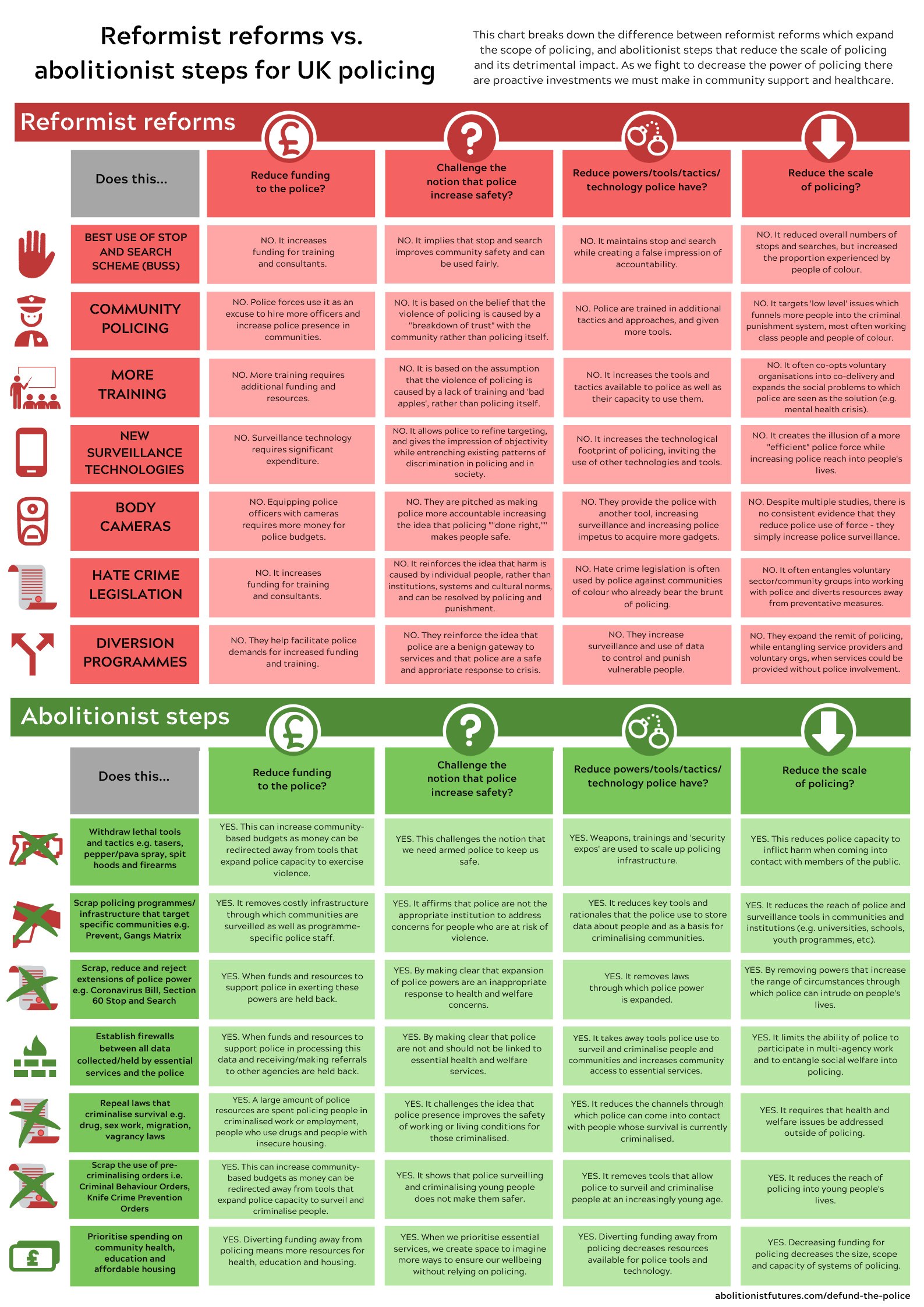
The purpose of this chart is to explain the difference between reformist reforms, which entrench or increase the reach of policing, and abolitionist steps, which reduce the overall reach and impact of policing while increasing the resources available to communities for health and flourishing.
We acknowledge that abolitionist steps in terms of policy go far beyond defunding the police. Carcerality exists in all areas of governance - including health, housing, education and culture, as well as the more obvious prisons, detention/immigration borders, and surveillance.
In sharing these resources we aim to support the development of anti-carceral, non reformist reforms/abolitionist steps in all these areas.
We work together towards the creation of an ‘Abolitionist policy platform’ so that we can collectively push for change across Britain and Ireland.
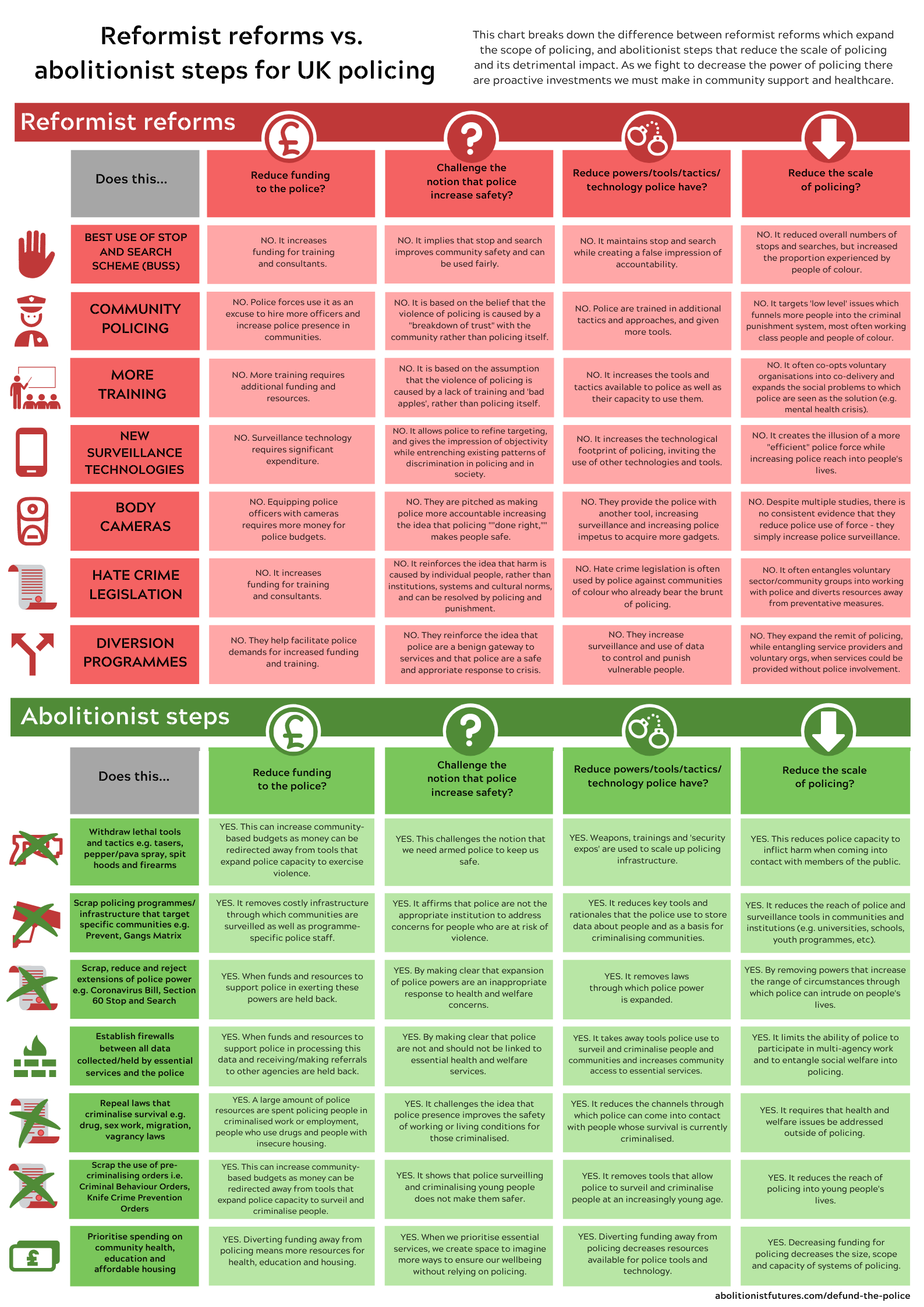
This resource was developed in summer 2020 by abolitionist academics, organisers and NGO workers from a range of groups to support British and Irish based abolitionist work and strategy in the context of global Black Lives Matter protests.
It adapts a resource developed by US-based group Critical Resistance, Reformist reforms vs.abolitionist steps in policing, and draws more broadly on the work of abolitionist organisers and scholars Mariame Kabe, Prof. Ruthie Wilson Gilmore, and Dr. Angela Davis, to whom we are deeply grateful.
These slides were created to go alongside the chart and be downloadable and sharable across social media platforms.
The designer’s Instagram handle is @rowanweatherwax

Sign with a graphic of a gun crossed out, and text stating 'Withdraw Lethal Tools and Tactics' with options 'Reformist reform' in red and 'Abolitionist step' in green.

Graphic illustrating lethal tools including a taser, pepper spray, spit hood, and firearm with text emphasizing these tools.

Graphic with a green British pound sign at the top, asking if reducing police funding decreases police capacity. The answer is yes, as funds can be redirected from tools that expand police violence, supporting abolitionist perspectives. The graphic includes green and black text on a yellow background.

An infographic questioning whether police increase safety, with a green question mark at the top, and a statement agreeing that it challenges the need for armed police, accompanied by a green check mark and the text 'Abolitionist step.'

Colorful infographic discussing police power reduction, with a green checkmark labeled 'Abolitionist step' and icons of handcuffs.

An infographic with a green downward arrow and a black rectangle with white text asking "Does it reduce the scale of policing?" The answer provided is "YES. This reduces police capacity to inflict harm when coming into contact with members of the public." Below, there is a green checkmark with the words "Abolitionist step" written next to it.

Sign with a red circle and slash over a gun, indicating no guns allowed. Text reads 'WITHDRAW LETHAL TOOLS AND TACTICS'. Green banner states 'Abolitionist step'. URL 'abolitionistfutures.com/defund-the-police'.

A graphic comparing community policing reformist reform and abolitionist step.

Infographic with a pound sterling symbol at the top, asking if reducing police funding affects police. The message states that police use the funds to hire more officers and improve community presence, not to reduce it, and promotes reformist reform with a red cross symbol.

A graphic questioning whether reformist reform challenges the notion that police increase safety, with a red check mark and bold text discussing police violence and community trust.

Infographic about police powers and tactics, with the question 'Does it reduce powers/tools/tactics/technology police have?' and the answer 'NO. Police are trained in additional tactics and approaches, and given more tools.' There is a graphic of two hand grenades at the top and a large red 'X' with the text 'Reformist reform' at the bottom.

A graphic with a red downward arrow, asking if it reduces the scale of policing, with text explaining it targets 'low level' issues and increases criminalization of working class and people of color, and a red X over 'Reformist reform'.
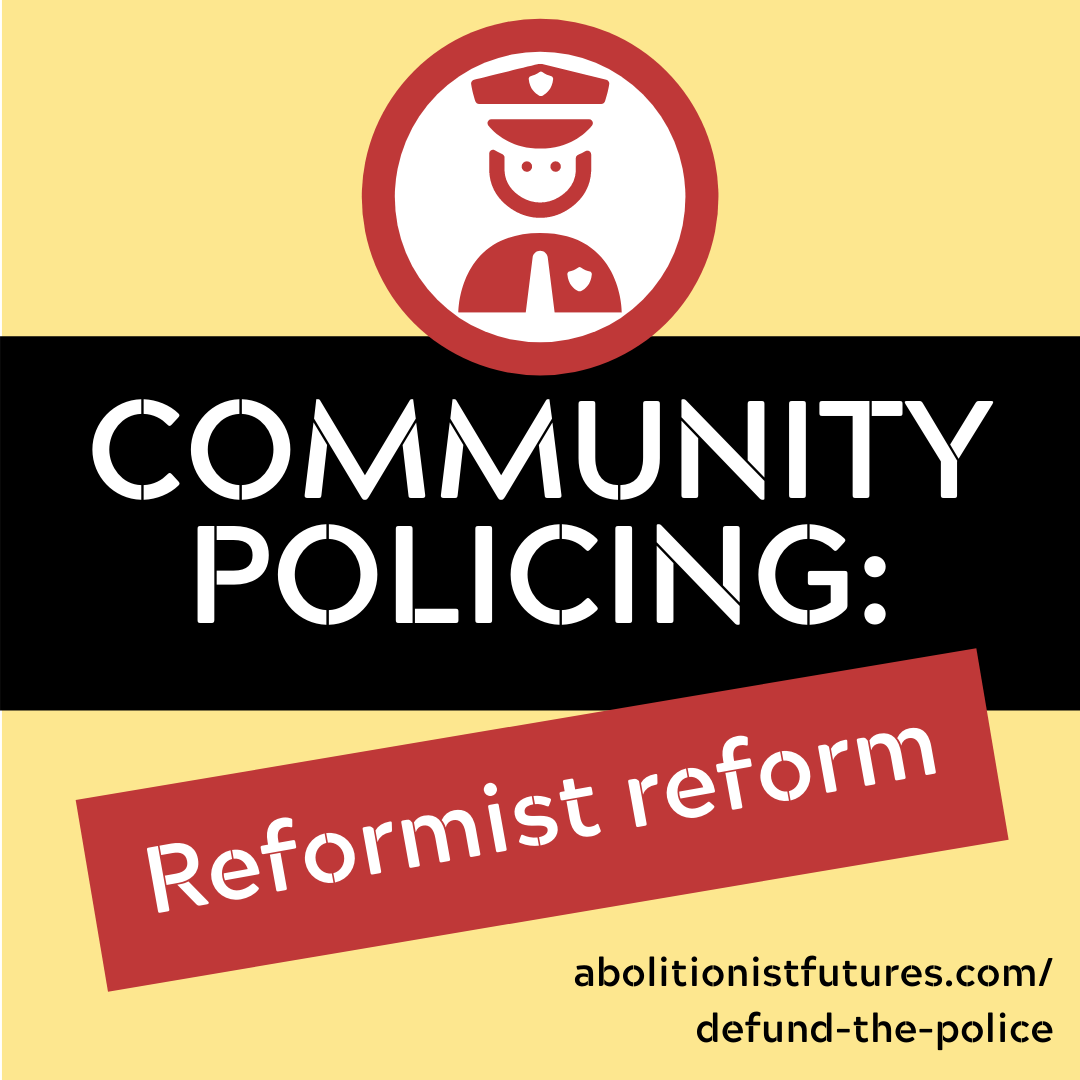
Poster promoting community policing reform with a police badge icon, bold text, and a website link.

Graphic promoting more training, with a symbol of a teacher and students at the top, and the text 'More Training' in the center. Below, there are options 'Reformist reform' in red and 'Abolitionist step' in green, with a question mark.

A graphic with a British pound symbol in a red circle at the top, asking if reducing police funding reduces police resources. The answer is no, more training needs more funding. A large red crossed-out circle with the words "Reformist reform" in red and black is at the bottom.

A graphic with a large red question mark at the top, a black box with white text asking, 'Does it challenge the notion that police increase safety?', a red box with white text explaining, 'NO. It is based on the assumption that the violence of policing is caused by a lack of training and 'bad apples', rather than policing itself.', and a black box with red text stating, 'Reformist reform', accompanied by a large red X.

Infographic questioning whether police reduce powers, tools, tactics, tactics, or technology, with a reply stating it increases tools and tactics available. The infographic is titled "Reformist reform" and features icons of handcuffs at the top.

An infographic with a downward arrow icon, asking if reform reduces policing scale. It states it often expands social problems instead. Features the phrase 'Reformist reform' with a red cross.

A poster advocating for more training and reform in the criminal justice system, featuring an icon of a teacher and students, with the text 'More Training: Reformist reform' and a website URL.

Graphic promoting new surveillance technology with an icon of a smartphone, asking if it represents reformist reform or abolitionist step.

Yellow background with black icons of a stethoscope and a helmet. Text reads: "New Surveillance Technology includes artificial intelligence, facial recognition and mobile phone tracking."

A graphic explaining that reducing police funding does not decrease crime because surveillance technology requires significant expenditure, promoting reformist reform.

A graphic with a red question mark at the top. Bold text asks if police reform challenges the idea that police increase safety. A red box states that reform does not challenge this notion but allows better targeting and creates an impression of objectivity while reinforcing discrimination patterns. A red X overlaps a black rectangle labeled "Reformist reform" at the bottom.

An infographic with a red icon of handcuffs at the top, a black box with white text asking if it reduces police powers or tactics, a red box with white text explaining it increases technological footprint, and a black box with red text saying 'Reformist reform' with a red X.

An infographic with a red downward arrow at the top, asking 'Does it reduce the scale of policing?' It states that it does not reduce the scale but creates the illusion of a more efficient police force while increasing police reach into people's lives. The infographic ends with a large red 'X' and the phrase 'Reformist reform.'

Graphic promoting new surveillance technology with a smartphone icon and text about reformist reform and abolishing police.

Graphic image with a red prohibition sign over a document icon and text reading 'REPEAL LAWS THAT CRIMINALISE SURVIVAL'. Below, there are two options: 'Reformist reform' in a red box and 'Abolitionist step?' in a green box.

Text on a light yellow background discussing laws to criminalize drug use and sex work, and repealing migration laws and vagrancy laws.

Graphic with a green pound sign icon, a question about reducing police funding, an answer supporting increased police resources for marginalized groups, and a checkmark with the caption "Abolitionist step".

An infographic with a green question mark at the top asking if it challenges the idea that police increase safety. The answer is yes, explaining that police presence improves the safety of criminalized individuals. There is a green checkmark at the bottom labeled 'Abolitionist step'.

An infographic with a green circle icon of two bombs at the top, and text discussing police powers and tactics reduction, with a green checkmark and the phrase "Abolitionist step" at the bottom.

A graphic with a green download arrow and a black box asking if a certain step reduces policing. The response says yes, it requires addressing health and welfare issues outside of policing. There is a green check mark and the words 'Abolitionist step' at the bottom.

A protest sign advocating for the repeal of laws criminalizing survival, with a symbol of a crossed-out police baton, and a green banner saying "Abolitionist step."

Graphic promoting prioritizing community funding for health, education, and housing. Features icons of a first aid kit, a light bulb with a book, and a house. Text reads 'Prioritize spending on community health, education & affordable housing' with options 'Reformist reform' or 'Abolitionist step?'

A graphic with a large green pound symbol at the top, followed by a black box with the question 'Does it reduce funding to the police?' and a green box with the answer 'YES. Diverting funding away from policing means more resources for health, education and housing.' Below, a green checkmark points to the words 'Abolitionist step' on a black background.

A political graphic with a green question mark, black and green text, and a green check mark. The text asks if the notion that police increase safety is challenged, and answers affirmatively that prioritizing essential services creates space for wellbeing without policing. It features the phrase "Abolitionist step."

A graphic with a police badge icon and questions about police technology, stating that diverting funding from policing reduces resources for police tools and technology, with a green checkmark and the text 'Abolitionist step'.

An infographic with a green downward arrow on top, questioning if reducing policing scales down the system, with a statement confirming that decreasing funding reduces size, scope, and capacity of police systems, and a checkmark labeled 'Abolitionist step'.

A poster advocating for prioritizing spending on community health, education, and affordable housing with symbols of a first aid kit, a book with a light bulb, and a house, and a green banner with the words 'Abolitionist step' and a URL.