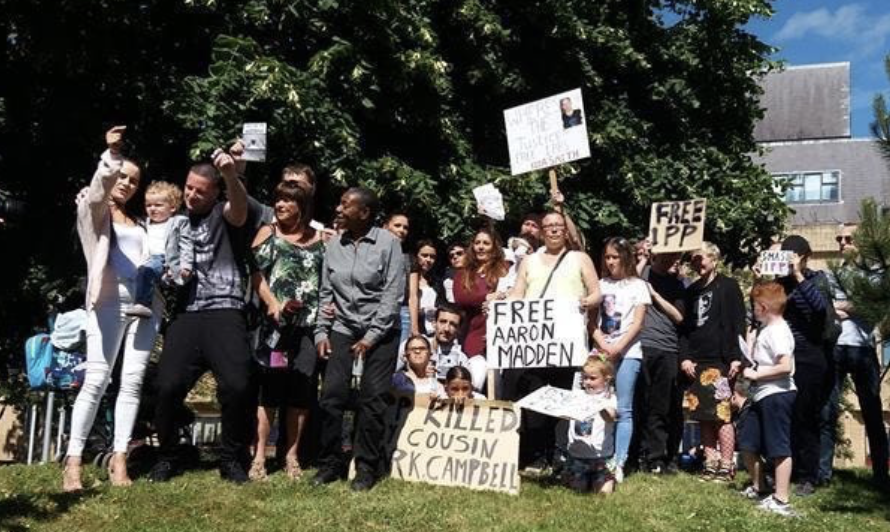
Protest Against IPP in Cardiff 2017
By Heledd Melangell
Welsh Mum Shirley Debono has for decades been fighting for her son, Shaun Lloyd, and all IPP prisoners stuck in prison serving an “Indeterminate Sentence for Public Protection”. Her and her son Shaun’s story needs to be told. For years Shirley Debono has led a fight that epitomised the kind of society we live in. The question of whose lives have value, and which lives are considered “not worth saving” by the powerful and their propaganda apparatuses. Her story has also led me to a further exploration of the potential of abolition in places like Wales, whose indigenous legal tradition is based on compensation, rather than carcerality.
As we trace the story of organised families fighting back against this sentence, we see that despite comparatively few IPP’s being Welsh, Wales has been a focal point in the struggle against IPP. Shirley, over decades has been the woman who has brought anarchists, prisoner families, politicians and solicitors together in this struggle, culminating in a case against the UK government in an international court.
As of March 2026 2,329 IPP prisoners in England and Wales were still indefinitely locked-up. They are at the mercy of parole boards. According to Shirley, who is in contact with dozens of IPP’s and their families, missing an appointment due to a public transport issue or admitting to using a Foodbank or in fact any sign that they’re “not coping” on the outside can be used as a pretext to recall to prison. Although the law around licence conditions was recently reformed in June 2026, the situation remains chaotic.
IPP - torture carried out by pencil pushers
How did we end up here? The IPP sentence was an indeterminate prison sentence - a sentence with a fixed (often short) minimum term but no release date - that was used in England and Wales from 2005 to 2012. It was supposed to be for those convicted of “serious violent or sexual offenses” who were deemed a “significant risk to the public”. The implementation of this sentence led to those convicted of very minor crimes and sentenced with IPP being given a life sentence. With the impact threatening to overwhelm the prison system, IPPs were abolished in 2013, but those already sentenced were left in prison indefinitely. Some are still in prison.Still in prison for stealing a bike, a phone or for getting into a fight as a teenager.
Prisoners sentenced to IPPs are held indefinitely until the Parole Board is satisfied that they are “no longer a risk”. Prisoners have to complete various courses and therapies to satisfy the tick box exercise of qualifying as being “no longer a risk” to the public. They have to wait years to get on over-subscribed courses and even have to wait to move to other prisons when where they are incarcerated doesn’t offer the course. More and more courses and therapy orders are added as prisoners complete them - making a nice profit for those profiting from keeping them in prison in this Sisyphian nightmare. In practice, austerity and the botched privatising of probation systems meant total chaos - and in prison, chaos means people die.
Some prisoners ordered to undergo therapy before release even had their “therapy” - used against them. Some prisoners who were suicidal because of their situation were deemed too unwell to be released. Some IPP’s, like Taylor, felt there was only one way out. An inquest found the IPP sentence being the biggest cause of the mental distress that led him to take his own life.
At the time of writing this article, 94 IPP’s have taken their own lives. This issue does not affect the prisoners in isolation either. They are part of families and wider communities of grief. Children are harmed by having a parent in prison and are 65% more likely to end up in prison themselves. Families have for many years been confronted with apathy by the politicians meant to correct this mistake. Labour in particular, although somewhat supportive in opposition - with David Lammy calling IPP “tragically flawed” - did very little to deal with this life and death crisis when they came to power.
Now in the face of the prisons crisis - suddenly it’s convenient to face the IPP issue. But exactly how we still do not know.
The Cardiff IPPs - Young, working class men serving life
IPP is fundamentally a class issue just as much as it is a justice issue - and often cited as “the greatest single stain there is on our justice system”. This was a law passed in England, and in Wales we were dragged along for the ride as England’s juridical appendage. There were 58 Welsh prisoners serving IPP in 2023, Shaun Lloyd, Shirley’s son being one of them. In my youth, I was part of an anarchist collective called “Smash IPP” - we worked with families to organise protests for IPP’s. There was the case of Kiya Smith in Ely, to Leroy Douglas from Splott and Shaun Lloyd. All of them were sentenced with IPP for petty theft, and are in prison for coming up to 20 years, albeit Kiya and Shaun have had brief periods of release before a crushing recall to prison. These lives are seen by the political establishment as disposable - and progress towards resolving the IPP issue has been at a snail’s pace until now, as the whole system faces collapse.
What is the political significance of the IPP’s? From having known dozens of IPP families over the years as a campaigner with Smash IPP - they always arrive at the intersection of youth and class - a section of society that those in power seek to control. Prison, social class and poverty are well established in research as things that go hand in hand, and this is also quite apparent in the case of IPP. Imprisonment is around three times greater in the five most deprived local authorities in Wales than the five least deprived local authorities. Public Health Wales conducted a “Prisoner Adverse Childhood Experiences Survey” in HMP Parc: 84% of male prisoners reported at least one ACE (Adverse Childhood Experience) compared to ~ 46% in the general Welsh population. Nearly half (46%) of prisoners reported four or more ACEs. According to PHW.
“These childhood adversities (abuse, neglect, domestic violence, etc.) are strongly correlated with future involvement in crime / incarceration, and ACEs are often linked to poverty / social disadvantage.”
Most of us that have had friends or family go to prison witness these patterns first hand. ACEs don’t mean “bad parents” are to blame for people going to prison. It means we are simply stuck in a system that fails families but prioritises the right of the few to become billionaires. Poverty psychologically breaks people. Parenting while juggling the mental load of bailiffs, housing precarity, planning every penny spent, often supporting others in poverty around you, is an epic struggle the middle class can be blissfully ignorant of. For pragmatic steps towards abolition, we need ideas rooted in the perspective of those bearing the brunt of it.
During an oral evidence session of the Welsh Affairs Committee on Prisons, Probation and Rehabilitation, Baron Timpson (Minister of State for Prisons, Probation and Reducing Reoffending - a family member of the Timpsons Cobbler’s empire) responded to questions of “Why does Wales have the highest incarceration rate in Western Europe”? With “I don’t know”. This was surprising since the well established links between poverty and prison has been established, and Wales has been ranked one of the poorest areas in Western Europe. In their book “The Jagged Edge” Rob Jones and Richard Wyn Jones also suggest that the chaos caused by justice not being devolved to Wales yet is a contributing factor to the fact that outcomes in justice being worse than that of England.
In a nation where one in every three children grows up in poverty - we are looking at a future of mass incarceration, reminiscent of the prison industrial complex boom in the United States. The explosion in the UK prison population in recent decades shows we are already gone far down this path, with Wales having the highest incarceration rate in Western Europe. Of course, those in poverty can be pushed to “criminality” to survive - but a disproportionate number of poor and working class people are in prison because the legal system’s middle and upper class custodians have unconscious bias that results in classist discrimination in court. The IPP sentence is the canary in the cage of this whole system. Even upon release, with no plan to support IPP’s needs, the trauma of the IPP sentence and harshness of licence conditions casts a dark shadow over the hope of freedom. What kind of freedom will it be without housing and material security?
English Justice Unfit for Wales
How would we do things differently in Wales?
Over a decade ago the Silk Commission recommended the devolution of justice to Wales. Three other major reports and commissions have also recommended the devolution of justice since then. Westminster however shows no sign of loosening its grip on power. Last year, Will Hayward’s Newsletter broke the news that 11 Labour Senedd members took out their begging cap, asking Starmer nicely and in private to treat our nation with some dignity and to stop undermining Welsh devolution, with justice being cited in particular. Plaid Cymru are now in power - they demand that justice is devolved, but it is yet to be seen if Westminster would trust the Welsh in this way. After all, my Father told me that when Meibion Glyndŵr burnt down hundreds of holiday homes in the 80’s as a defense to the erosion of Welsh communities, England police were sent to investigate as they did not trust the local police force not to be sympathetic to the cause. With Welsh Independence increasing in popularity, will England readily hand over its monopoly on violence?
Rob Jones and Richard Wyn Jones’s book “The Welsh Criminal Justice System: On the Jagged Edge” illustrates how the lack of coordination between services such as social services, housing and justice is a factor in outcomes being worse in Wales in terms of justice. England, whose institutions are more “joined up” has a legislative advantage. The priorities in England that focus on large inner cities issues such as knife crime are largely irrelevant in Wales. Here in Wales we have the highest incarceration rate in western Europe and a more racist criminal justice system than that of England. People in Wales are paying the price. Initiatives that could prevent people from ending up in prison cannot be planned for and the statistics show the result.
To think of the progressiveness of Hywel Dda’s laws, this feels like a sharp deviation from our legal legacy. Hywel Dda’s laws were the system of law adopted by the Welsh before colonisation, which for its time had progressive elements especially in terms of women owning property and divorce. Interesting for abolitionists that rather than a carceral system of justice it was one based on compensation.
We are not taught about our own legal history pre 1282 (when Wales was conquered) in school. Adam Price’s article from 2009 (though not unproblematic in places) taught me how little I really know of my own history. The piece by Price posits how our experience of colonisation by England resulted in “cymleth y taeog”, a psychology of subordination manufactured by cultural and economic domination by England. Has this led us to think that our own legal tradition based on compensation, community prevention and reconciliation are subordinate to the punitive and vengeful English approach to justice? Price in now part of the Plaid Cymru Senedd government in Wales - I feel like this means in finding a Welsh conception of justice, there is a potential route to argue for models based more on Hywel Dda’s abolitionist orientated laws (though it feels strange calling them “abolitionist” as they pre-date carcerality).
The Welsh language and national liberation activist Emyr Llewelyn, (who was himself imprisoned for bombing a dam project that displaced a Welsh community - Tryweryn) said in his essay on Welsh justice, that the way we combat British dominion over the concept of justice is to “behave as if we are already free”. This is reminiscent of another national liberation movement, with historic connections to the Welsh movement; the Kurdish Freedom movement. Their system of democratic confederalism has birthed groundbreaking, progressive systems of women led restorative justice in their communities, despite living under harsh and colonising nation states - this is a justice system of dual power that we could put to work. I find it interesting that nations without states are abolitionist innovators. We can also look to Scotland, with its progressive and abolitionist drug laws - there is something here for English Abolitionists to learn from.
Emyr Llywelyn advocated for a “Gyfraith Hywel Newydd” a new form of Hywel Dda’s law practiced in our communities, where we ignore the English legal system and conduct our affairs through our ways. Strikingly similar to the Kurdish model as a creative response by another stateless nation to a judicial system that does not work for them. Wales and Kurdistan are worlds apart, and it would take a whole society effort to make a grassroots system like this work - but in light of the terrible harm caused by the British judicial system, we need to do better for victims in our society. The prison system fails them most of all. For people with family in prison, like myself and Shirley - it’s time for a new approach.
As we await to hear what Burnham’s release plan is for the IPP’s, it’s hard to see how without housing, safe drug supply for those that suffer from addiction, without community support, without any help in adjusting, what will be the IPP’s fate? From a prison made of bricks of mortar most will enter the prison of poverty, and “illegality” for those stigmatized and deprived of so much for so long. Can abolitionists organise and create initiatives? In the USA the film "Visions of Abolition" shows a stark example of prefiguration as people are released from prison. Every tool in the box should be used. In Wales we have the avenue of possibilities open to us that rather than focus on the devolution of British justice to the Welsh government, we adopt the concept of non-reformist reforms and look to our legal legacy of Hywel Dda could offer a generative route to Welsh abolition.
Please attend this protest Organised by Shirley:
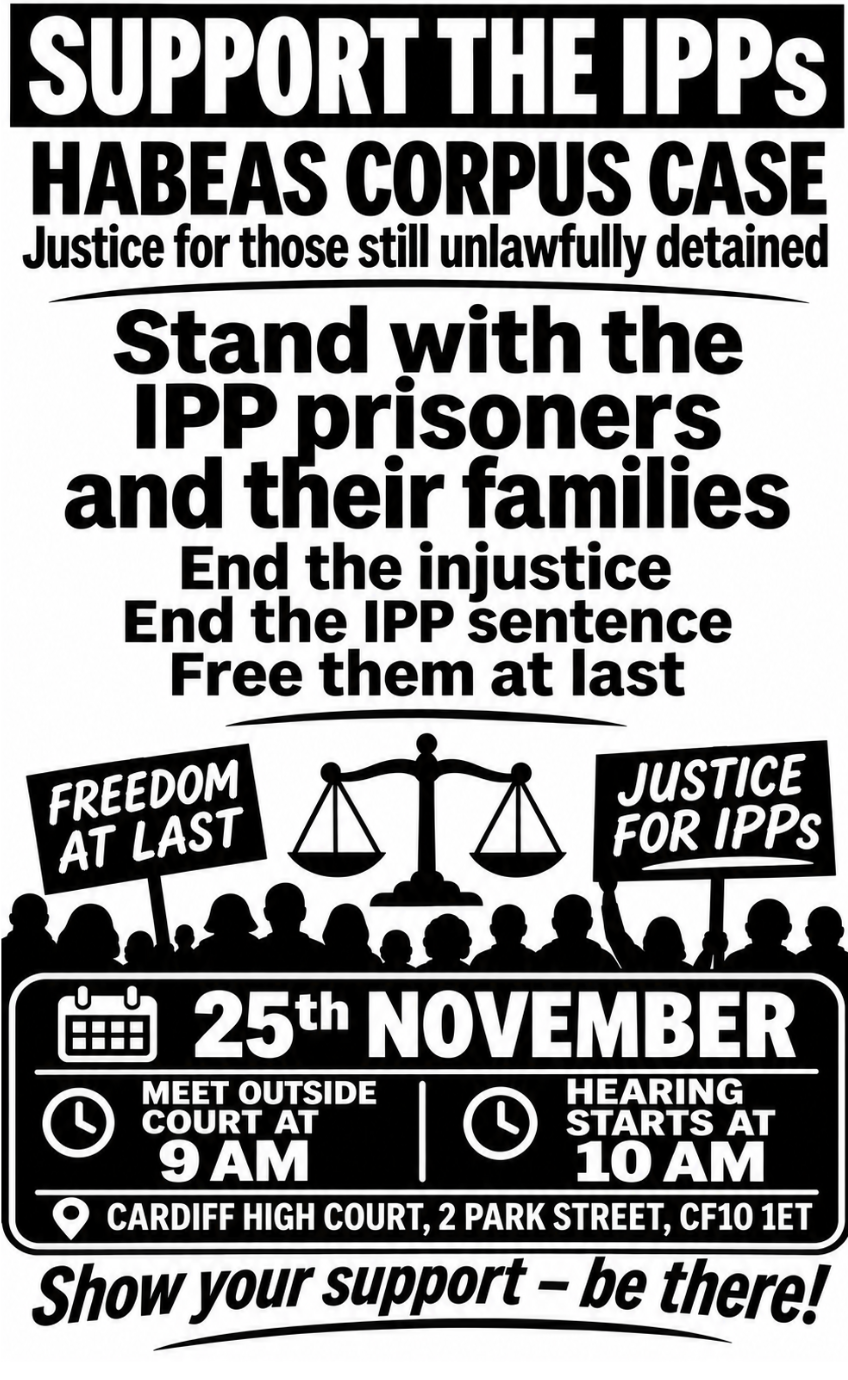
Poster advertising Demo outside Cardiff High Court 25 November
Heledd is a PhD candidate in Sociology looking at the intersection of the Welsh language and social class. She was an abolitionist activist before having kids.
Instagram: @heleddmel