By Alex Bruno, Elisa Modica, Irene Santoro
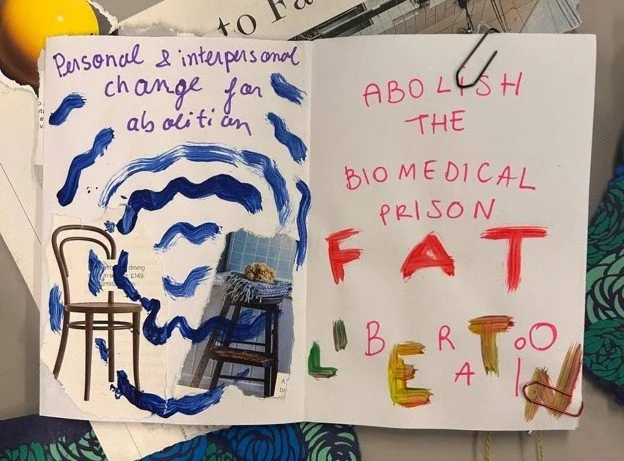
Zine created by Alex in the context of a creative workshop organised by Abolitionist Futures in 2026
On 12 February 2026, police raided the homes of at least six doctors in Ravenna. The charge was “falso ideologico”, falsifying medical certificates. The certificates in question declared a number of migrants unfit to be held in a CPR, a centro di permanenza per il rimpatrio. This is one of Italy's ten administrative detention centres, where people who don't hold a residence permit and cannot be deported immediately are locked up while the state arranges to deport them. Under a 2022 ministerial directive, anyone entering a CPR is first supposed to undergo a medical visit, to rule out anything from infectious disease and psychiatric illness to chronic conditions that can't be treated inside and that the centre's overcrowded and restrictive conditions would make worse. In this instance, the Ravenna doctors examined the people brought before them, assessed what detention would do to their health, and certified them unfit.
The Federazione Nazionale degli Ordini dei Medici Chirurghi e degli Odontoiatri (FNOMCEO), Italy's national federation of medical associations, described this as doctors doing their job and refusing to let their clinical judgment decide who the state gets to detain. "Using doctors as instruments of public-order control is a mistake," said its president, Filippo Anelli. "It is contrary to our code of ethics." Seven months later, the case has grown. On 16 September 2026, police searched twenty-three doctors, most of them infectious disease specialists and psychiatrists, across nine cities from Milan to Bari. The Ravenna prosecutors are now working on the hypothesis of an organised network, an “associazione per delinquere finalizzata ai falsi ideologici” (conspiracy to commit ideological falsification), with doctors actively working to keep people out of detention. Only one of the twenty-three has been formally placed under investigation: Nicola Cocco, an infectious disease specialist with the Società Italiana di Medicina delle Migrazioni (SIMM), a former consultant to Italy's National Guarantor for the rights of detained persons, and one of the doctors who had publicly criticised the first investigation. Matteo Salvini, Minister of Infrastructure and Transport and leader of the Lega, responded that if found guilty, the doctors should be struck off the medical register and made to pay damages "out of their own pocket" for the missed expulsions of every “clandestino” (undocumented migrant) they allegedly protected. FNOMCEO answered again: "i medici non sono ausiliari delle politiche di sicurezza", doctors are not auxiliaries of security policy.
In February, clinical judgment that got in the way of detention was treated as individual misconduct. By September, it is being investigated as organised crime. Nobody has been convicted of anything as of now, but the message is clear: the state uses matters of health to control the population.
We are opening this series with this story because it sums up almost everything we want to say across the next three posts. Health and medicine are political. Health produces carceral logic and presents it as care. In Ravenna, they became a site of resistance to carceral logic, as best described by Martinex and Murkejee in the book All This Safety Is Killing Us: Health Justice Beyond Prisons, Police, and Borders (Abolitionist Frameworks and Practices from Clinicians, Organizers, and Incarcerated Activists):
“Health practitioners and health justice advocates are essential to advising… abolition. They not only help us care for our bodies and minds but assist us in practising the skills necessary for collective care.”
These blog posts aim to show how this happens in practice, by analysing fat liberationist politics and applying it to questions of abolition.
Why fat liberation is an abolitionist question
At the 12th Weight Stigma Conference in Oslo this June, Dr. Lily O'Hara presented a Declaration on Weight Stigma, Size and Weight Inclusion, and Fat Liberation, developed collectively with colleagues and activists since the 2025 conference and due to be published soon. Among other things, the declaration puts forward a definition of fat liberation itself. It states that fat liberation is "an explicitly abolitionist movement…".
The declaration doesn't specify what it means by "abolitionist," and read on its own, that word could point in more than one direction. For us, the connection to prison abolition specifically is not incidental. It sits close to the centre of how we understand fat liberation, and we should be explicit.
Fatness became a racialised characteristic before it became a medical one. In Fearing the Black Body: The Racial Origins of Fat Phobia, Sabrina Strings traces how the modern uplifting and obsession for thinness developed alongside, and as part of, the racial science used to justify slavery and colonial rule: fatness was coded as Black and animalistic, thinness as evidence of white, Enlightenment self-discipline. Da'Shaun L. Harrison, in 2021, builds directly on this history in Belly of the Beast: The Politics of Anti-Fatness as Anti-Blackness, arguing that anti-fatness and anti-Blackness are not two oppressions that happen to overlap. They are the same logic, produced together, still operating together now, including in the specific violence that anti-fatness enables against fat Black people. That means talking about fat liberation without talking about the prison industrial complex (PIC), and about who the PIC targets, leaves out exactly the people who experience this the most.
Body fascism and the fit national body
Da’Shaun has since pushed this argument further. In a March 2026 piece for Scalawag, they named the pattern body fascism:
"the promotion of an 'ideal' body type as a symbol of patriotism [...] in service of a nationalist agenda, while 'non-ideal' bodies experience increased violence and erasure."
The ideal they describe is thin or muscular, "productive," white, cisgender, heterosexual and militarisable, and they trace its measuring tools back to Adolphe Quetelet, the nineteenth-century statistician whose index became the BMI and whose work was later taken up by eugenicists. Crucially for us, Da’Shaun argues that this does not need open authoritarianism to work: "neoliberal democracies have perfected body fascism precisely by disavowing it and recasting coercion as care." Recasting coercion as care is exactly what the CPR medical visit was built to do, and exactly what the Ravenna doctors refused. A health check meant to protect people becomes the gate through which they are sorted into detention.
Beatrice Adler-Bolton and Artie Vierkant's Health Communism (2022) helps explain why states invest so heavily in this ideal body. They argue that capital has turned health into one of its primary tools, using it to divide people fit to work from a "surplus" population cast as a fiscal and social burden, and then handing that surplus over to industries that profit from managing and containing it. That sorting depends on treating health as an individual possession, earned through discipline and lost through personal failure. Here, thinness is read as visible proof of self-government, of a citizen who will never cost the collective anything, which is how the thin body comes to stand in for the healthy national body. As a result, fat bodies get read as burdens the nation has to manage.
For the same reason, Adler-Bolton and Vierkant see health as capitalism's point of greatest vulnerability. Everyone will need care at some point, and a politics that refuses to measure the value of a life by its productivity breaks the sorting mechanism at its root. The Ravenna doctors offered a small version of that refusal: a clinical judgment that declined to answer the question of fitness on the state's terms.
This is also the position of fat liberation organisers, beyond theorists. Fat Rose, a fat liberation and disability justice collective, held "Busting Out: Fat Lib & PIC Abolition," bringing together conversations on carcerality, anti-fatness, bodily surveillance and transformative justice. Their vision statement ties fat liberation directly to the liberation of Black and Indigenous people, disabled people, queer and trans people, and everyone else targeted by the carceral state, and calls outright for that state to end.
Abolitionists working on psychiatric detention have already made the same move, treating what looks like care as something closer to containment. In "Care or Confinement? An Abolitionist Perspective on Psychiatric Detention," published on this blog, Oscar Sharples writes about the routine failures of the psychiatric system to care for the people inside it, particularly autistic patients, and argues that "the very idea of psychiatric institutionalisation centres around isolation and containment, not care." The label of mental illness, like the label of "ob*sity", is one people have little control over, and it gets used to justify segregating them from exactly the community support and connection that keeps people well.
The same question can be asked of how medicine handles fatness. Why is weight loss so often set as a precondition for other care? Why does a Body Mass Index (BMI) number decide whether someone is offered, for example, physiotherapy or fertility treatment, or is believed about their own pain? Why are fat people routed toward surveillance and restriction in the name of health, rather than support? Applying an abolitionist lens to "ob*sity" medicine leads to the same conclusion Sharples reaches about psychiatric wards: what's on offer works as a mechanism for isolating and correcting bodies treated as a problem to manage, rather than people to support.
Weight loss injections (GLP-1s) sharpen every one of these questions. Earlier regimes of weight control ran on deprivation and shame, from commercial diet programs to the demand to lose weight before any other treatment. Starvation and restriction were, and are in a lot of experiences, framed as a public health concern and as a risk to the nation's strength, with the fit, muscular body standing in for resilience and control. On the surface, GLP-1s leave that behind. They have travelled from endocrinology clinics into the media as responsible medicine, shaping how people understand fatness and how they feel about fat people, and fat Black people most of all. At a Death Panel session at Socialism 2026 in September, Da’Shaun argued that
"the political deployment of GLP-1s is fascistic not because individuals take them but because the conditions under which they become necessary are shaped by a world fixated on genociding fat people."
Eugenics never disappeared; it got absorbed into other techniques. GLP-1s now work as a people-sorting mechanism that reclassifies the "undesirable" as correctable. As Da’Shaun argues, fat flesh, and fat Black flesh in particular, gets read as temporarily incorrect, a body in progress. Whoever can't or won't be corrected becomes disposable: care is withheld, the structural conditions shaping their lives go ignored, and the social and physical death that follows is recorded as personal failure. Lauren Berlant called this slow death, a concept she developed in writing about "ob*sity" itself. Delivered as a prescription, it becomes a form of eugenics far more people are ready to defend. Slogans like "Make America Healthy Again" turn health into a collective state of the nation, while people keep experiencing capitalism through their own bodies. So who benefits when a pharmaceutical industry that embodies body fascism is normalised as the provider of care? And what future is being built on it?
This is why fat liberation cannot remain a project about representation or self-esteem alone, the path body positivity took once it was absorbed into marketing from the mid-2000s onward. No amount of gentler bedside manner, adjusted BMI cutoffs, or other anthropometric measures changes the underlying structure, any more than reforming psychiatric wards changes their basic function as tools of isolation. What abolition asks of fat liberation is what it asks of psychiatric care: a different starting point, where people get the resources and relationships they need within their own communities instead of being separated and managed until they comply. In the GLP-1 era, with Ozempic, Wegovy and Mounjaro reframing fatness as a condition with a pharmaceutical fix, that different starting point is more urgent than ever.
However, the relationship runs both ways. Abolitionist spaces don't automatically arrive at this on their own. It is entirely possible to imagine a world without prisons, borders or psychiatric wards that still quietly assumes a "healthy", thin, disciplined body as its baseline moral value, a wellness-and-self-optimisation version of liberation that never asks who gets left out of it. If abolition means refusing every system that isolates and manages people instead of supporting them, it has to include the systems built around fatness too. That is the reciprocal claim this series is making: fat liberation needs abolitionist analysis to see the full shape of that structure, and abolitionism needs fat liberation so its imagined future doesn't quietly rebuild the fit national body under a new name and logic.
Anti-fat bias in the criminal justice system
Anti-fat bias is also measurable, and it is rooted in exactly the process of medicalisation described above. Once fatness is classified as a medical deviation from a "normalised" body, rather than simply a body characteristic, it becomes available for judgment as a moral failing too. Julie Guthman describes biopolitics as the constitution of "normalized bodies, which evolves continuously based on these standards", and argues that this is the foundation for marginalisation: neoliberal capitalism shapes the social and economic meaning of "obesity" in ways that turn fat people into cultural Others, subjected to oppression within a hierarchical power structure. Medicalisation, in other words, goes beyond describing fat bodies as unhealthy. It produces fat people as a category of people who can legitimately be treated as less credible and more at fault.
That production shows up directly in the criminal justice system. Carels and colleagues (2024) found that participants who scored higher on measures of anti-fat bias, when judging ambiguous sexual assault scenarios, assigned significantly more responsibility to the survivor and significantly less to the perpetrator than participants with lower anti-fat bias. Zidenberg and colleagues (2019), examining sexual coercion specifically, found that participants shown a fat survivor reported more sympathy for the perpetrator, endorsed more excuses on his behalf, and expressed less negative affect toward him than participants shown the identical scenario with a thin survivor. These findings describe how fat women, and fat people who also belong to other marginalised groups, are actually treated as they move through reporting, being believed and being taken seriously by the systems presumably meant to respond to violence against them.
This is where anti-fatness becomes carceral. A criminal justice system decides, case by case, who counts as a credible victim deserving protection and who counts as someone who probably brought it on themselves. Anti-fat bias, built on the same normalising logic that produces the "obesity paradigm", is one of the mechanisms doing that sorting.
What comes next
Over the next two posts in this series, we will take this further. One post looks at how diet culture and calorie logic function as an internalised panopticon, a way of getting people to police their own bodies so thoroughly that no external guard is needed. The other imagines what an abolitionist future asks of us if we take fat liberation seriously inside it: a world free of prisons and borders, and free also of the quieter architecture of shame and self-surveillance that carceral "health" so often provides cover for.
Health matters, and medicine can be practised otherwise. The doctors investigated in Ravenna, and the twenty-three searched this month, show that clinical judgment exercised with real ethics can push back against a carceral system instead of serving it. If health is where people get sorted into fit and unfit, it is also where that sorting can be refused. What we are asking is that we stop treating "health" as neutral, apolitical ground where carceral logic has no business operating, because it has been operating there the whole time, for migrants and for fat people and for plenty of others besides.
Naming that is the first step. The rest of this series is about what we do with it.
About the authors
Alex Bruno (they/them) is a queer trans non binary activist, researcher, community organiser and fat rights advocate with the Italian fat liberationist collective Grassi Diritti. Alex is a PhD Student at the University of Greenwich with a doctoral project on “Imagining FAT Utopias: FAT Worldmaking and Collective Resistance Among FAT Workers,” which explores the experiences of FAT people in the sex industry and beyond. Their academic work focuses on the experiences of participatory and collaborative methodologies, sex workers and fat peoples rights, and subversion of the medicalisation of fatness. They hold a Bachelor of Arts in Sociology and a Master in Applied Criminology from the University of Greenwich.
Email: ale.alex.bruno@gmail.com
Linkedin: www.linkedin.com/in/alex-bruno
Instagram: @alebrunooo
Elisa Modica (any pronouns) is a queer agender activist and fat rights advocate with the Italian fat liberationist collective Grassi Diritti. Elisa works as a clinical psychologist, specialising primarily in psychological support for neuroqueer people, trans individuals on their gender-affirming journey, and polyamorous constellations. They also support clients seeking to deconstruct fatphobia and diet culture through weight-inclusive and harm-reduction approaches. Elisa holds a Bachelor of Science in Psychology and a Master of Science in Psychology of Social, Economic, and Decision-Making Behaviour from the University of Milano-Bicocca.
Email: e.modica999@gmail.com
LinkedIn: https://www.linkedin.com/in/elisa-modica
Instagram: @smoodi
Irene Santoro (she/her) is a fat woman, fat activist with the collective Grassi Diritti. She holds a Bachelor’s degree in Foreign Languages, a Master degree in Art History and a postgraduate degree in Gender Studies. Since 2021 Irene has carried out research on the intersection of gender and fat studies. Irene is currently a PhD student at University of Lleida in Catalonia with a project titled “The Making of bodies in heteronormativity: gender and fatness in the construction of the woman’s body”, which explores the embodied experience of fat women in the western culture.
Email: irenesantorounipg@gmail.com
Linkedin https://www.linkedin.com/in/irene-santoro
Instagram: @ire_miaooo