Book review by Rachele Girardi
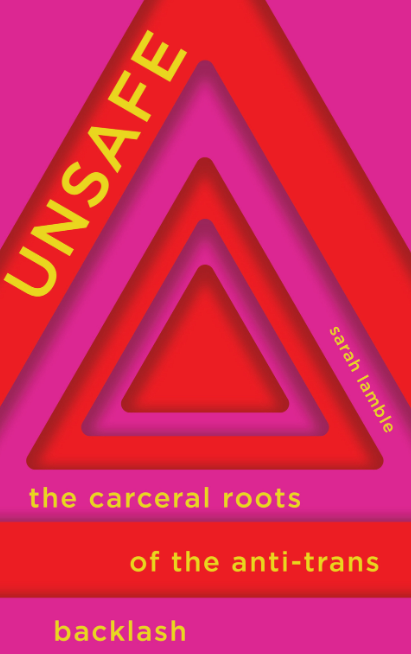
Unsafe by Sarah Lamble is published by Haymarket Books (£14.99)
To say that I was looking forward to reading this book would be an understatement. As a feminist abolitionist, Lamble’s work has been central to both my intellectual and political education. Yet, I should begin with a warning: this is not an easy read. Reading this book has been a challenging, complex, and at times uncomfortable introspective journey, involving a critical reflection on my own attachments to safety, harm, accountability, and innocence. At the same time, it has felt like a breath of fresh air. The book helped me unpack contradictions within my own abolitionist commitments and opened up the possibility of imagining something radically different on the horizon.
This is a book for all of us. It is for activists, organisers, abolitionists, feminists, trans and queer people, racialised communities, people with lived experience of policing and imprisonment, and those currently incarcerated. It is equally a book for academics, students, and researchers seeking to critically examine the concepts that sustain the criminal legal system: safety, harm, and justice. It brings together some of the most difficult questions many of us encounter in our work, relationships, communities, and organising. What makes us truly safe? What does safety for all concretely mean? Through eight chapters rich in case studies, academic scholarship, activist knowledge and personal accounts, Lamble shows us that we cannot rely on carceral forms of safety; we must build safety collectively. The book offers a compelling analysis of contemporary safety politics through the lens of the UK’s gender wars and anti-trans backlash. In doing so, however, it achieves much more than that.
Lamble’s central argument is that the rise of anti-trans politics in Britain, from the political fringes to the mainstream, reflects a fundamentally carceral understanding of safety. A safety based on identifying and excluding “dangerous others” through policing, punishment, and imprisonment, whilst failing to reduce violence or create safer communities. Rather than treating anti-trans sentiment as an isolated expression of transphobia, Lamble situates it within a broader system structured by racial capitalism, transphobia, queerphobia, misogyny, and ableism, which generates and depends upon conditions of insecurity and harm. Reading the book led me to consider how unsafety is produced both materially and symbolically, together with the limitations of prevailing approaches to safety and justice, and what it might take to move collectively towards a transformative future. Such a future requires not only changing the material conditions that can enable people to flourish outside carceral systems, but also the difficult work of confronting and unlearning our own internalised carceral and disposability logics.
The introduction situates the gender wars within a broader historical context, tracing key developments, such as the UK Supreme Court ruling of 2025. Lamble demonstrates how anti-trans sentiment can unite actors across political affiliations, from right to left, because gender-critical groups can mobilise deeply rooted fears surrounding gender-based violence, male violence, and essentialist notions of women’s vulnerability. The only viable solution that is proposed is to rely on punitive responses. Lamble also acknowledges how punitive logics have been adopted by sections of LGBTQ+ and trans advocacy movements, particularly in relation to hate crime legislation, as well as by strands of carceral feminism. I found myself reflected in this discussion: as a young Criminology student, I too once accepted the seemingly straightforward assumption that increasing hate crime violence had to be coupled with increasingly harsher penalties for those who harmed. That equation began to fall short as I listened to people with lived experience of policing and incarceration and came to grips with the realities of racial capitalism and the violence that the carceral system itself perpetuates, preaching protection and safety, but making most of us affectively and materially unsafe.
The book then proceeds into three parts. The first examines the carceral roots of the anti-trans backlash. Across three chapters, Lamble analyses the construction of the “transgender predator,” tracing its emergence through debates over prison placement, gender recognition policies, and campaigns framed around protecting women and children from the supposedly dangerous “trans other,” most often represented by trans women. A central consideration from this section is that victimhood and trauma are frequently weaponised in debates about safety to signal who deserves more recognition for their pain. The logic of whataboutism emerges here: What about rape survivors who feel unsafe sharing spaces with trans women? What about trans women who face discrimination, exclusion, and violence? Thinking about safety as conditional to the identification of a potential victim and a potential perpetrator means that we will never reach a condition where everyone feels safe. Instead, this approach works by reproducing the perennial fear of external threats, legitimising surveillance, vigilantism and consensus on the need for carceral forms of safety against a common enemy.
Chapter 3, “how we got here,” is particularly valuable for its historical analysis of carceral safety politics. Lamble demonstrates that contemporary understandings of danger and carceral safety did not emerge suddenly but are rooted in the punitive turn that has characterised British (and international) politics since the 1980s. Law-and-order politics and growing reliance on state funding affected mainstream feminist and LGBTQ+ organisations, which became increasingly entangled with the criminal legal system (see Cowan 2024). This historical perspective helps illuminate how gender-critical politics slowly became the “logical extension” of wider social anxieties concerning violence and insecurity, the anti-woke backlash, and moral panics surrounding “dangerous men”, with trans women cast as “predatory men in disguise” (p. 83).
Part Two shifts focus to the failures of carceral politics, particularly in relation to sexual violence. Chapter 4, “dangerous others,” is among the most powerful chapters of the book. Lamble seeks to break down the binary between victim and perpetrator, arguing that sexual violence occupies an exceptional position within our contemporary understanding of harm. Through what they term the “carceral politics of sex exceptionalism” (p. 88), sexual violence is constructed as uniquely heinous and fundamentally distinct from other forms of harm, allowing us to distance ourselves from the uncomfortable reality that sexual violence is pervasively common in our families, communities, and institutions, and that individuals can simultaneously occupy the positions of victim and perpetrator.
I found this analysis especially powerful, as I have often viewed sexual violence through exceptionalist lenses, making it hard, if not morally impossible, to escape punitive responses. Yet Lamble demonstrates how sex exceptionalism affects not only punitive responses to sexual harm, often obscuring broader structural realities, but also the legal, social, cultural and personal implications for those who have harmed, as well as those who have been harmed, together with broader patriarchal, racist and sexist assumptions associated with sexuality. Once we de-exceptionalise certain forms of harm, and we move beyond the binary of victim and perpetrator, innocence itself becomes a much more complex notion. However, the criminal legal system is not built to recognise this complexity. This is why reform is a “failed promise”, because it does not change the structural conditions enabling carceral harms - what is needed instead is “a radically different vision of safety: one that is holistic, transformative, and explicitly anti-carceral” (p. 107).
Part Three begins to outline that alternative vision through three interconnected principles: shifting from symbolic to material safety, from individual to collective safety, and embracing the principle that no one is disposable. Chapter 6, “from symbolic to material safety,” is another of the book’s most compelling and, at times, painfully familiar sections. Through examples such as public bathroom debates and the Ministry of Justice’s updated prison placement policies, Lamble demonstrates how safety is constructed along the axes of gender, race and class, and how forms of exclusionary safety (p. 129), that is, safety identified through exclusion of the “dangerous other” - trans women and gender non-conforming individuals - does not equate to real safety. The symbolic threat attributed to trans bodies has material consequences which are often overlooked: as legal and policy developments demonstrate, symbolic protection often results in exclusionary violence, marginalisation and unsafety. While legal recognition and trans-inclusive symbolism remain important, Lamble urges us to distinguish between symbolic representations of safety and the material conditions that produce harm.
The following chapter explores the shift from individual to collective safety. Drawing on the murder of Brianna Ghey and the erasure of the role of transphobia in the legal proceedings, Lamble argues that contemporary understandings of safety are often individualised. Safety becomes a matter of self-management, surveillance, cop-like behaviour, and individual responsibility, obscuring the role that power dynamics have in determining people’s exposure to harm. This feeling isolates us and pits us one against the other, under the rhetoric that, if something bad happens, perhaps you were not careful enough, not cautious enough, not clothed enough, not passing enough. Against this logic, Lamble argues that violence and harm must be understood as collective problems requiring collective solutions (p. 163). This means creating the collective resources, networks, and infrastructures needed to address harm and safety outside of carceral institutions.
Among the brilliant resources included in the book, particularly inspiring is the work of Healing Justice London on building “life-affirming institutions”:
“Healing Justice frameworks invite us to reimagine safety as a community-based (vs. state-controlled) endeavour that is rooted in collective care (vs. individual self-preservation), affirms and preserves human life (vs. property), values autonomy (vs. control), promotes harm reduction (vs. criminalisation), and works towards liberation (vs. retribution) (p. 167).”
As social, not institutional, networks are the ones we first turn to when we are exposed to harm, strengthening these becomes essential. We need to build on their capacity for safety and support through upskilling, connections with alternative infrastructures and resources to transform how we respond to harm, reaching a point where calling the police is not simply unnecessary, but obsolete.
The last Chapter proposes what I found to be the book’s most difficult and important proposition: no one is disposable. As addressing harm and safety becomes a material and collective endeavour, we also need to reckon, individually and collectively, with the idea that we cannot leave anyone behind. Drawing on a powerful personal account, Lamble argues that solidarity and ethics of care cannot be conditional. If people can simultaneously experience victimisation and perpetrate harm, then meaningful accountability requires us to reject the assumption that some lives are worth less than others. This is deeply challenging because we have been socialised to believe that certain lives can be sacrificed for the protection of others and our safety relies on the incapacitation, exclusion, and social death. Even within our progressive and radical movements, we can see disposability politics emerging: we have all been tempted to identify those we dislike, disagree with, or condemn as unworthy of our solidarity. This politics of “radical non-exclusivity” (see Gilmore, 2022) starts from an introspective reckoning with our own attachments to carceral safety logics.
In reflecting on these arguments, I returned to a quote from artist and healing justice practitioner Amahra Spence, cited on page 139: “We need to get so much more comfortable and brave about being uncomfortable”. Transformation does not emerge from comfort. More often, it is the difficult, unsettling work that produces meaningful change. Transformation is also not immediate; it is an ongoing practice, and we do not have to undertake it alone. The book identifies how across communities and movements, transformative justice initiatives have already demonstrated alternative models of support, accountability, and collective survival grounded in the belief that nobody should be left behind.
The concluding pages offer one of the most hopeful insights of the book: transformative safety is not a distant aspiration, but something that is already being created in the present. At a time when insecurity is weaponised, and disposability has become a dominant political logic, Unsafe could not be more urgent. It serves as a critique, a call to action, and a map directing us towards the places where transformation is already happening, in the work of “trans youth organisers; anti-carceral feminists; prison and border abolitionists; racial justice collectives; survivor-led community support projects; and transnational intersectional justice movements” educating, supporting and fighting to build safer futures (p. 203). Lamble reminds us that we can lean on each other to learn, unlearn and attune to this work towards forms of safety that are material, collective, and transformative – after all, we keep us safe.
If there is one book to read this year on trans politics, abolitionist feminism, and transformative approaches to safety and justice, let it be this one.
Are you looking for a space to discuss the book, share your reflections, ask questions, and think together about the future of transformative approaches to safety and justice? Abolitionist Futures is launching a Book Club with four online sessions running from October 2026 to January 2027.
More details will be shared soon. In the meantime, if you’re interested in joining, please fill out the form below, and we’ll keep you updated.