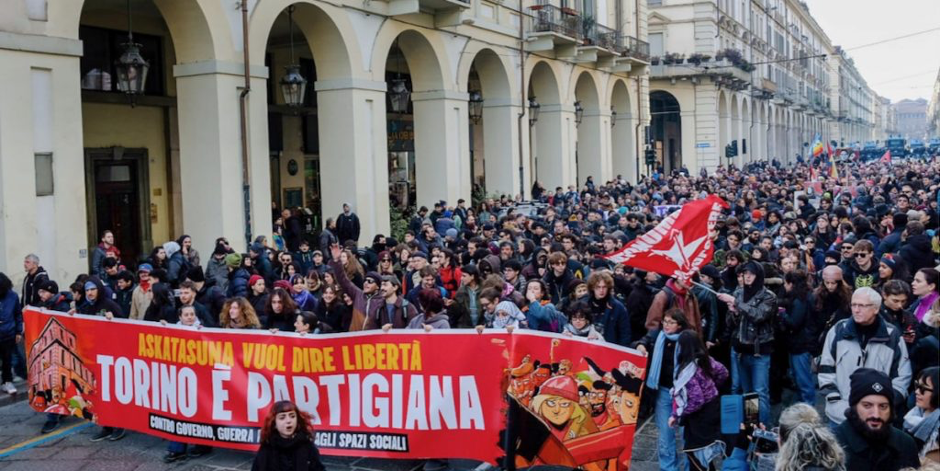
Photo: Renato Ferrantini, Dinamo Press CC BY-NC-ND 2.5 IT
By Rachele Girardi
Abolitionist thinking and praxis invite us to challenge everyday assumptions about justice, punishment and violence. This article considers the violence of policing and the state repression of protesting by reflecting on recent clashes with the police that erupted during a national demonstration in Turin, Italy, on 31 January 2026. More than 50,000 people gathered to protest the eviction of a self-managed space in the country, the Askatasuna social centre in Turin. Their slogan was “Askatasuna means freedom. Turin is partisan. Against the government, the war and the attacks on self-organised spaces”. Though situated in a specific Italian context, this case illuminates wider national and international patterns of protest policing, and shows how political actors and media frame state violence as the sole legitimate means of “order maintenance”, while criminalising dissent and portraying protesters’ violence as illegitimate, deviant and anti-democratic.
Askatasuna and social centres in Italy
The protest in Turin was organised in response to the eviction of the social centre Askatasuna, a long-standing self-managed space (or CSOA, Centro Sociale Occupato Autogestito) that was established in the 1990s, and forms part of an Italian tradition of occupying abandoned spaces and reclaiming them for community use without formal ownership. Askatasuna has been linked to a series of investigations between 2009 and 2022, during which prosecutors linked militants and political groups active in the centre to revolutionary ideologies and alleged violent attacks, including those associated with the No Tav movement in the Susa Valley. Although the conspiracy charges were dropped in 2022, the eviction in 2025 was prompted by Askatasuna’s breach of an agreement with the local council and the use of unauthorised spaces of the squatted building.
To better understand the demonstration of 31 January, it is necessary to situate Askatasuna and the broader tradition of CSOAs within the Italian context. The emergence of social centres (centri sociali) as self-managed squatted spaces in Italy dates back to the 1970s and is shaped not only by a desire for community among youth inspired by counter-cultural trends, but also by a general disenfranchisement, disillusionment with and mistrust towards state authorities. These hubs have been central in the development of political consciousness, radical politics and political organising, often associated with struggles led by the working class and marginalised communities in large cities like Rome or Milan. Beyond serving as hubs for discussing counter-hegemonic politics and mobilising against social inequalities, discrimination, genocide and capitalism, social centres have also offered younger generations a place for shelter, to nurture community and to engage in mutual aid.
While militants active in Askatasuna have always been open about their views on the use of violence in certain conflict dynamics with the state, the recent national and local governments’ attack on social centres, involving evictions in Milan (Leoncavallo) and Vicenza (Boscodromo), signals a growing institutional unease towards political dissent and counter-mobilisation. Yet, the charge of “squatting” is routinely employed to justify the closure of social centres and support their eviction, without considering the vital services these spaces provide to the community, including housing advice, domestic violence support, children’s activities and food co-operatives. It is also striking to consider how political groups that appear more closely aligned with the existing government, such as the far-right social centre CasaPound, which has occupied a building in Rome for 23 years, have not received the same hostile treatment, highlighting the politically selective treatment of squatting and political organising.
Askatasuna means freedom - The protest
The events of 31 January in Turin involved the mobilisation of more than 50,000 people from all over Italy in solidarity with Askatasuna. The subsequent clashes with the police have been portrayed by the media as yet another pacifist march that was “infiltrated” by a violent minority and turned into mayhem, an “urban guerrilla”. This portrayal echoes similar media narratives around other recent protests in Italy that escalated into violence, such as the pro-Palestine demonstration in Milan in September 2025, which was described as a “war zone” as demonstrators actively confronted police cordons. Here, the dichotomy between violent and non-violent protesters should be carefully examined: while it is outside of the scope of this article to discuss the ethics and morality of violence, I follow Marcello Tarì’s call to move beyond the reductive binary between violent and non-violent protesting. This distinction already assumes the moral primacy of pacifist forms of dissent, which not only depoliticises the use of violence during protests and misrepresents it as violence for violence’s sake, but also reproduces assumptions around whose violence can be legitimised under contemporary neoliberal democracies. The use of war-like language in media coverage of the protests therefore acquires a symbolic meaning, positioning protesters as agents of war who must be repressed by all means necessary, including the deployment of hundreds of riot police.
It is important to note that the violent episodes did not define the entire day of the demonstration, but started later in the afternoon, around 6 p.m., when people started dispersing and a group of activists moved towards the Askatasuna centre to meet police cordons stationed there and on the main roads. According to media accounts, this moment marked the end of the “organised manifestation” and the beginning of what has been described as an “orchestrated riot”, with activists throwing Molotovs, fireworks, bottles and stones, and the police responding with physical confrontations, tear gas and water cannons aimed at human height. Amid this chaos, a viral video started circulating that showed a group of protesters assaulting a lone police officer, kicking him to the ground and striking him, allegedly with a hammer, until another police officer arrived and shielded him from the crowd. The clip rapidly spread from social media to mainstream news coverage, where commentators were denouncing the “bestiality” of the attack and the “heroism” of the police officer who intervened to rescue his colleague. In the aftermath, Prime Minister Giorgia Meloni visited the hospital to meet the two injured police officers, calling the attack an “attempted murder”, alongside attacks on more than 100 agents, with headlines denouncing the attackers as “loose dogs”, claiming 30 have been identified and 3 arrested on the day for “collective violence”. Within this well-crafted reconstruction of events, the two wounded police officers are portrayed as the martyrs, victims of a type of violence that cannot be sanitised. This is the violence of dissent, criminalised and cast by the public discourse as pure barbarity.
Nevertheless, more recent recollections and testimonies from participants in the crowd paint a completely different picture, suggesting that the viral video had been edited or taken out of context. These accounts mentioned how the lone police officer seen in the footage might have initiated the escalation by striking an activist with a baton, after which others intervened to defend him and attacked the police officer. The image of the attack posted by law enforcement on social media was also edited using AI, increasing speculations of an orchestrated attack against the police to accelerate the government’s security decree (decreto sicurezza). This decree, approved on 25 February 2026, has introduced a series of repressive measures aimed at countering “organised aggressions” during protests, including preventative detention up to 12 hours for individuals considered likely to commit violence during demonstrations, increased stop and search powers, and tighten rules on self-defence provisions, which could actively shield police officers who react with the use of force. According to Deputy Prime Minister Matteo Salvini, these measures are "the best antidote to immediately block the extreme left's attempt to bring violence back to the streets of Italian cities", while Defence Minister Guido Crosetto likened these events to “urban terrorism”, drawing on comparisons with the Brigate Rosse, an Italian militant left-wing organisation responsible for a series of terrorist attacks in the 1970s. The narrative of revolutionary terrorism is used to delegitimise dissent and cast it as an existential threat to the state, which makes it easier to justify extraordinary measures to ensure the “security” of the nation.
Because this was the dominant media portrayal of the events, what did not make the headlines was the violence perpetrated by the riot police towards members of the public who were not displaying any violent behaviour. This included a widely shared video of an elderly man with his face covered in blood after being struck by a police officer, and footage of law enforcement randomly beating crowds of people with batons and firing teargas. Such acts, legitimised by the state and carried out by state agents, were not considered as violence, but as riot control and order maintenance directed against alleged “internal enemies”. While the violent protesters were all identified, arrested and charged, the absence of individual identification numbers for police officers in Italy means that no one will be held accountable for striking an elderly man without cause, or deploying teargas at human height with the potential intent to injure, rather than maintaining order. Because this type of violence is the only one recognised as legitimate, no one is truly responsible: no one is, or will ever be, identified or charged. This dynamic broadens this article’s critique to the broader criminal justice system, as it demonstrates how procedures and legal frameworks systematically shield state actors from accountability, while simultaneously criminalising the actions of protesters.
Disobedience, state repression, and the need for abolition
This case, although embedded within a specific national context, can be used to examine how the state constructs the figure of a “common internal enemy”, an “anarchist other”, who is portrayed as posing a direct threat to the status quo through violence depicted as unjustifiable and vile. The repressive power of the state is not only visible in the heavy deployment of riot police at demonstrations, who often initiate or escalate violence, but also in the ability to shape and manipulate dominant public narratives about those events. In this instance, the government and right-wing political parties’ propaganda around stopping “aggressions against law enforcement” reveals a broader concern with preserving the legitimacy of the state’s monopoly on violence in the eyes of the public. This monopoly involves not only the control over the means of violence, but also the proscription of violence by non-state actors, in contrast with police’s “procedural authorisation to use coercion”. The state achieves this by treating the violence perpetrated by law enforcement in this and past episodes as a “necessary evil” required to maintain order and protect the public. In other words, the state deems as illegitimate and criminal only those acts of violence that are directed against the state itself, as further clarified by Rasmussen (2020):
States rarely use the term “violence” when carrying out legal acts of coercion. In the language of the state, “violence” is committed by “criminals” or “perpetrators”—never by the state. The state, thus, conceals its own use of violence with legislative rhetoric.
This case illustrates the state’s concern around alternative modes of collective and political organising that exist outside of formal institutions, a concern that extends beyond the Italian context. The misrepresentation of self-managed social centres as party places for outcasts or bases for terrorist organisations is not only misleading but also a deliberate attempt to undermine collective forms of dissent. In Italy, the government is signalling its readiness to militarise against dissent, showing the burgeoning power it holds not only in actively deploying law enforcement against protesters, or in the use of militarised evictions, but also in steering public opinion against a common internal enemy, alluding to a state of chaos in need of restoration. The state effectively recognises disobedience only when it is framed as the illegitimate use of violence: the population disobeys and demonstrates dissent through means automatically marked as criminal, even though these means often mirror the very tactics the state uses to impose order, such as the use of physical force. This violence, coded by the state as disobedience, cannot be sanitised or integrated into a legitimate political discourse. In this way, the explicit attack on the “illegitimate” use of violence functions as a means to an end: it justifies the suppression of broader forms of dissent that emerge outside the formal channels of political decision‑making, de facto depoliticising them.
An abolitionist reading of this case invites us to critically consider the use of violence that goes beyond policing alone, implicating the work of the criminal justice system and the state. More specifically, it asks us to consider the state’s heavy reliance on policing to maintain “order”; whose order is being upheld; and the weaponisation of public discourses to construct a common enemy against which this order is justified. As Williams has argued, “the police represent the point of contact between the coercive apparatus of the state and the lives of its citizens” (p. 98), meaning that the repression of dissent acts not only through direct physical coercion, batons, teargas and arrests, but also through the labelling of certain bodies as “criminal”, “violent” and “deviant”. In this framework, the violence of the protesters is marked as illegitimate and unforgivable, prompting a state of chaos and warfare that legitimises exceptional state measures. However, the militarised policing, the security decree, and the demonisation of self‑managed social centres are not exceptional responses to isolated outbursts of urban violence, but part of an ongoing state project to suppress dissent. As Walter Benjamin made clear: “the tradition of the oppressed teaches us that the ‘state of emergency’ in which we live is the rule”, not the exception (Thesis VIII).
Rachele Girardi (she/her) is a Lecturer in Criminology based in the UK. Her work is shaped by her involvement with abolitionist collectives and focuses on police violence, criminalisation, and the imprisonment of marginalised communities through queer and feminist perspectives. She uses creative and participatory research methods to centre the voices of people with lived experience of criminalisation and to imagine concrete possibilities for abolitionist futures.
Email: girardirachele31@gmail.com
Linkedin: www.linkedin.com/in/rachele-girardi-7a8089130
Insta: @ggrrrrachel