By Elisa Modica, Irene Santoro, Alex Bruno
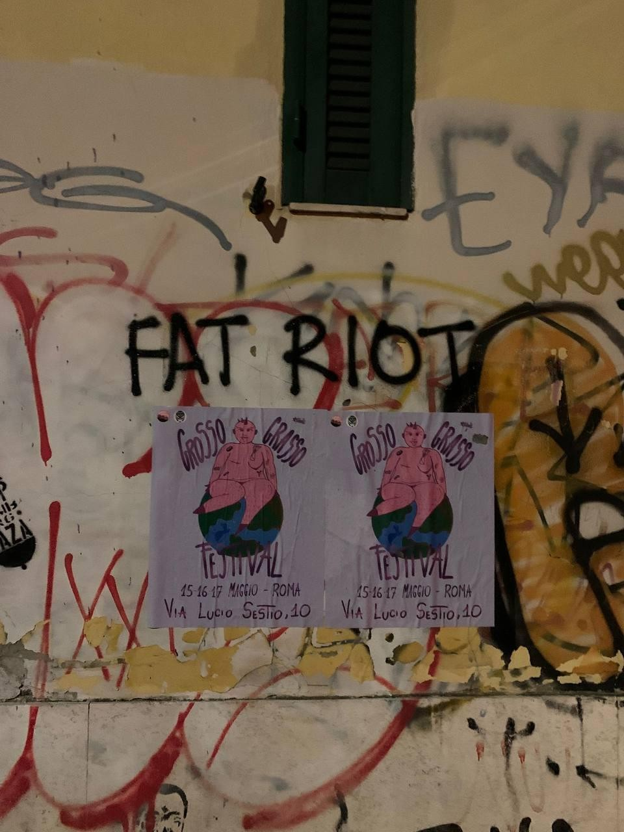
“Fat Riot” graffiti and the first Grassi Diritti’s Fat Italian festival’s poster in Rome, 2026
In the first post of this series, we argued that health is one of the places where carceral logic does its sorting. Starting from the doctors investigated in Ravenna for certifying migrants unfit for detention, we looked at how medicine decides who counts as fit and who gets managed, and at how anti-fat bias shapes who is believed when they move through the criminal legal system.
This post turns to a form of surveillance that needs no prison walls to operate: the dietary Panopticon. Originally theorized by Jeremy Bentham as an architectural model for prisons and later expanded by Michel Foucault to explain modern disciplinary power, the Panopticon relies on a central watchtower from which an unseen guard can observe inmates at any moment. Because prisoners never know when they are being watched, they internalize the gaze and police themselves. As Foucault writes in Discipline and Punish, the major effect of the Panopticon is “to induce in the inmate a state of conscious and permanent visibility that assures the automatic functioning of power”. Applied to anti-fatness, this framework reveals how bodily oppression shifts from external surveillance (medical charts, public commentary, institutional policies) to internalized discipline, producing subjects who continuously regulate, restrict, and punish their own bodies on behalf of the system.
Anti-fatness is enforced through systems, and it is also enforced by people on themselves, every day, through the rules diet culture teaches about food and bodies. Diet culture is not merely a set of dietary recommendations. Fat people can encounter diet culture in many aspects of life: from relentless medical gaslighting where every symptom is pathologized as weight-related, to constant unsolicited comments from family and colleagues, workplace discrimination, inaccessible seating in public spaces and media representations that reduce fat bodies to tropes of failure or deviance. It is a regime of discipline, control and obedience that enters the mind, saturates it with rules, prohibitions, alarms, that turns people into their own jailers.
In an abolitionist framework of body liberation, diet culture operates as what Christy Harrison calls the "Life Thief". By keeping individuals trapped in constant anxiety over food and weight control, this pervasive system takes up the time and attention they would otherwise give to pleasure and to each other. It isolates individuals from social spaces and holds their minds hostage even during moments of gathering, eroding their ability to engage authentically with the world. Dismantling body oppression requires recognizing that reclaiming our bodies is fundamental to reclaiming our right to fully inhabit our lives and relationships.
In the language of Intuitive Eating, a framework created by Evelyn Tribole and Elyse Resch that actually originated from the radical roots of the mid-20th-century Fat Liberation movement—which fought against medical pathologization and body policing—the Food Police can be understood as the internal voice of the dietary Panopticon. Diet culture establishes rules about what, when and how much one should eat; once these rules are internalized, individuals begin to monitor and discipline themselves even when no external authority is present. The Food Police therefore reproduces panoptic power from within, turning meals, hunger and pleasure into objects of constant surveillance, automatic thoughts, constant judgment, anticipated shame, permanent surveillance and moral judgment.
The 2022 systematic review by Bidstrup et al. examined internalized stigma as a mediator between experienced weight stigma and biopsychosocial outcomes, finding consistent evidence particularly for disordered eating. People learn to observe themselves, judge themselves, and anticipate orders. This is where the violence of the norm becomes most efficient, when it no longer needs to present itself as violence: operating as what Lauren Berlant defines as "slow death"—the gradual wearing out of populations, bodies, and capacities under the ordinary conditions of structural violence. In the context of anti-fatness, this attrition is tangible and cumulative: it wears down cardiovascular and metabolic health through chronic weight-cycling and cortisol spikes; it erodes digestive and neurological functioning through prolonged starvation; it exhausts cognitive bandwidth and emotional resilience; and it steadily strips away social trust, medical safety, and the capacity for bodily joy. Rather than acting as a sudden executioner, anti-fatness operates as a quiet, systemic mechanism of attrition that wears down fat lives day by day.
In the great period of dystopian experiments, between 1944 and 1945, The Minnesota Starvation Experiment was conducted at the University of Minnesota, involving 36 psychologically and physically healthy (which was understood by them as not showing any symptoms or diagnosis of illnesses at the moment of the experiment) conscientious men. The aim was designed to help scientists understand how to rehabilitate people suffering from famine and war-related starvation, while also improving nutritional-relief programs for populations facing food shortages. During the semi-starvation phase (six-month period during which participants’ food intake was reduced to around 1600 calories per day to simulate wartime famine conditions), most participants lost more than 25% of their body weight and developed profound physical and psychological symptoms, including fatigue, depression, weakness, apathy, irritability, anemia, neurological problems, reduced concentration, loss of libido and disturbing dreams.
They were predictable effects of prolonged restriction imposed on people “without any visible symptoms or illnesses”. As starvation progressed, food became an obsessive focus: participants spent increasing amounts of time thinking about eating, discussing food, collecting recipes, reading cookbooks and imagining meals. Their attention narrowed around food, while concentration, social engagement, sexuality, and everyday interests declined.
Some participants developed compulsive or unusual behaviors related to food, including prolonged chewing, food rituals, hoarding and obsessive preoccupation with weight and eating. These reactions show that when the body is deprived, the mind does not simply become more disciplined: it becomes increasingly occupied by the struggle for nourishment.
The so-called loss of control is not a personal defect, it is the body’s predictable biological response to deprivation. Yet, fat people are routinely pathologized for this exact mechanism. When fat individuals experience the neurological and physiological consequences of chronic dieting it is falsely attributed to a lack of willpower, moral failure, or inherent dysfunction, rather than recognized as the natural defense of a body subjected to state and culture-sanctioned starvation.
Modern diet culture has cleverly rebranded itself under the guise of "wellness" and "lifestyle" choices, yet its underlying mechanics remain rooted in body surveillance and control. By forcing individuals into constant hyper-vigilance over "good" and "bad" foods, tracking and compensation, this system steals precious mental bandwidth that could otherwise fuel collective activism and meaningful living, as Laura Thomas extensively explains in her book “Just Eat It". Packaging food restrictions as "abundance" merely induces a psychological scarcity mindset, elevating restricted foods onto a pedestal and perpetuating toxic cycles of shame, obsession and deprivation. Food is neither a site of moral trial nor something to be mastered; true liberation requires rejecting the institutional logic of bodily regulation and reclaiming our right to nourish ourselves without restriction.
Scarcity theory describes what happens when a resource is perceived as insufficient, threatened or constantly at risk of running out. Under these conditions, attention tends to become concentrated on the absence through a process known as tunneling: the mind prioritizes what relates to the perceived emergency and temporarily neglects other goals and information.
Mullainathan and Shafir developed this framework to explain poverty, but dieting reproduces these conditions by design. A person on a diet lives with food scarcity in the middle of abundance: the food is there, and eating it is the transgression. The men in Minnesota had their food taken away by researchers. Diet culture teaches people to take it away from themselves, and the tunneling process that follows is the same. Scarcity can consume precisely the cognitive resources required for self-regulation. It asks us to control ourselves more and more, while the control regime restricts the mental conditions that would make flexible self-regulation possible.
The more a person fears losing control, the more they monitor food. The more they monitor food, the more food preoccupies the mind. The more food preoccupies the mind, the more desire and hunger become threats. The more they become threats, the more rigid control becomes.
This is where scarcity meets the Panopticon, and where interpersonal, institutional, and state-sanctioned anti-fatness lock together into a single feedback loop. The interpersonal gaze of a stranger on a bus, a family member at dinner, or a colleague at work does not exist in a vacuum; it is authorized and trained by medical institutions that equate thinness with virtue and fatness with pathology. Those institutions, in turn, derive their authority from state policies and public health campaigns that frame fat populations as an economic and biological threat. Because the judging gaze is reinforced across every scale (from the intimate to the legislative) surveillance spreads from the plate to hunger itself, to photographs, and to the physical space a body occupies. It ceases to be an isolated act and becomes the permanent background condition of a person's attention, already narrowed by scarcity.
This perspective becomes particularly urgent in Italy following the passage of Law n. 149 of 3 October 2025, which originated as a bill introduced by Roberto Pella. The law establishes principles concerning the prevention and treatment of ob*sity, defining it as a progressive and relapsing disease associated with other comorbidities, while authorizing a national program, training activities and a dedicated national observatory.
From an abolitionist perspective, the medical pathologization of body size is the institutionalization of the Panopticon. By legally defining fatness as a chronic disease to be prevented, managed and tracked through a national observatory, the state codifies a centralized apparatus of biological surveillance. The watchtower is no longer just internalized through diet culture but it is written into state policy. Under this law, fat bodies are formally framed as population-level risks to be monitored, corrected and contained. This becomes even clearer when examining the legislation's structural limits: while authorizing surveillance, national programs, and observational infrastructure, the final text does not automatically guarantee these services within the Essential Levels of Care (Livelli Essenziali di Assistenza - LEA). In the Italian National Health Service, the LEA represent the core basket of medical treatments and diagnostic services that the state is legally obligated to provide to all citizens free of charge or at a minimal co-payment. Excluding services from the LEA means that concrete, accessible medical support remains unfunded or subject to regional disparities and out-of-pocket costs, whereas the mechanisms for data collection, clinical classification, and behavioral monitoring are immediately codified into law. The medical panopticon does not promise actual care or universal access to support for those who desire it. Instead, it establishes a system designed to observe, measure and police. To determine which bodies must be prevented and tracked is to declare which bodies are inherently unacceptable, and as a result deemed disposable.
A genuinely anti-fatphobic health policy must dismantle this panoptic machinery. It requires holding together two non-contradictory demands: guaranteeing universal access to non-stigmatizing care while rejecting the premise that health requires perpetual weight surveillance. Care cannot mean institutional surveillance. Prevention cannot mean teaching individuals to view their own bodies as state-monitored medical errors. Against the hyper-individualizing logic of diet culture (which isolates people in private shame and demands personal bodily compliance), we must build infrastructures of collective care. In practice, this means shifting resources away from weight-loss surveillance and toward weight-neutral healthcare, universal access to eating disorder recovery, accessible public environments, peer-led mutual aid, and material support that addresses the social determinants of health (such as housing, rest, income security, and freedom from discrimination) without ever demanding that a body shrink in order to deserve care.
Reducing a person to a diagnostic category treats body size as a universal explanation for pain and turns every clinical encounter into an enforcement of the norm. A liberated healthcare system must offer support without imposing shame, addressing mobility, pain, metabolic health or eating disorders, without transforming the body into an enemy of the state, and of the self, or an object of permanent surveillance.
Abolition means:
Abolishing the moralization of food
Abolishing the idea that thinness proves virtue
Abolishing surveillance as a condition of respectability
Abolishing the belief that every body must prove that it deserves space.
Diet culture promises freedom from the body, but often produces a mind imprisoned by the body. It produces scarcity, then calls the ability to endure it virtue. It produces shame, then sells control as the solution. It creates the problem and offers the guard.
In these first two posts, we have mapped the mechanics of our present reality. But carceral logic and anti-fatness are not the end of the story. They are the walls we intend to dismantle.
In the next post of this series, we turn our gaze toward a radically different horizon: a future built on genuine abolition. We will reclaim the concept of health as we interpret and want it: freed from the coercive, ableist, and sanist standards imposed by systemic oppression. After exposing the structures that constrain our present, our third post will demonstrate that an abolitionist future is not just a dream, but an urgent necessity we can actively build together now, in the present.
About the authors
Elisa Modica (any pronouns) is a queer agender activist and fat rights advocate with the Italian fat liberationist collective Grassi Diritti. Elisa works as a clinical psychologist, specializing primarily in psychological support for neuroqueer people, trans individuals on their gender-affirming journey, and polyamorous constellations. They also support clients seeking to deconstruct fatphobia and diet culture through weight-inclusive and harm-reduction approaches. Elisa holds a Bachelor of Science in Psychology and a Master of Science in Psychology of Social, Economic, and Decision-Making Behaviour from the University of Milano-Bicocca.
Email: e.modica999@gmail.com
LinkedIn: https://www.linkedin.com/in/elisa-modica
Instagram: @smoodi
Irene Santoro (she/her) is a fat woman, fat activist with the collective Grassi Diritti. She holds a Bachelor degree in Foreign Languages, a Master degree in Art History and a postgraduate degree in Gender Studies. Since 2021 Irene has carried out research on the intersection of gender and fat studies. Irene is currently a PhD student at University of Lleida in Catalonia with a project titled “The Making of bodies in heteronormativity: gender and fatness in the construction of the woman’s body” which explores the embodied experience of fat women in the western culture.
Email: irenesantorounipg@gmail.com
Linkedin https://www.linkedin.com/in/irene-santoro
Instagram: @ire_miaooo
Alex Bruno (they/them) is a queer trans non binary activist, researcher, community organiser and fat rights advocate with the Italian fat liberationist collective Grassi Diritti. Alex is a PhD Student at the University of Greenwich with a doctoral project on “Imagining FAT Utopias: FAT Worldmaking and Collective Resistance Among FAT Workers,” which explores the experiences of FAT people in the sex industry and beyond. Their academic work focuses on the experiences of participatory and collaborative methodologies, sex workers and fat people’s rights, and subversion of the medicalisation of fatness. They hold a Bachelor of Arts in Sociology and a Master in Applied Criminology from the University of Greenwich.
Email: ale.alex.bruno@gmail.com
Linkedin: www.linkedin.com/in/alex-bruno
Instagram: @alebrunooo