From the prison notebooks. By Amu Gib.
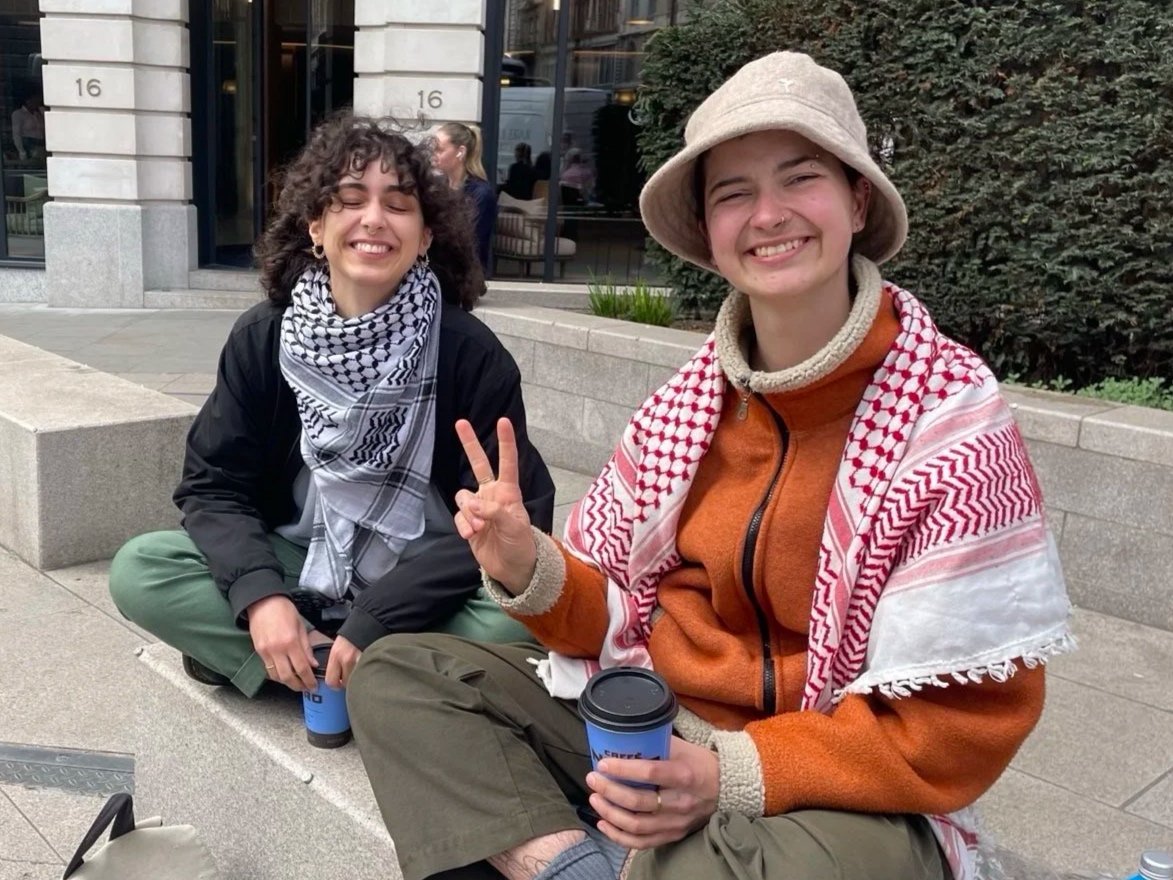
Amu and Carys at the Old Bailey. Photograph taken by Ray
Introduction by Jiaqi Kang
On 26 June 2025, my friend Amu was raided and arrested by counter-terror police. They were held at Newbury Police Station for a week before being remanded to HMP Bronzefield, where they’ve been incarcerated ever since.
Amu and five others—Umer Khalid, Dan Jeronymides-Norie, Lewie Chiaramello, Jon Cink, and (as of May 2026) Lara Downes—are the Brize Norton 6, accused of breaking into RAF Brize Norton in Oxfordshire and spray-painting two RAF Voyager planes suspected of supporting Israel’s genocide in Gaza. Soon after the Brize Norton incident, the UK government proscribed Palestine Action as a terrorist group.
The Brize Norton 6’s trial is set for January 2027, and with bail applications repeatedly denied over the course of the past year, this means that Amu, Umer, Dan, Lewie, and John are expected to spend 18 months in prison (and Lara, seven months) without a single conviction.
As abolitionists, we understand that ‘political prisoner’ is a misnomer. All prisoners are political. Prisoners like Amu, incarcerated for protest, are not exceptional figures who should be considered separate from the rest of the incarcerated population, those ‘real criminals’ who seemingly do deserve to be in prison. While I understand that allies have good intentions when they say Protest is not terrorism or Protest is not a crime, this rhetoric is painfully short-sighted because it doesn't address the premise of the carceral system itself. The fact is that our friends are criminals, because the state has criminalised them. The far more important question is how states get to decide who counts as a criminal, who should be imprisoned, and who should be punished.
Needless to say, these mechanisms are deeply racialised, and attempts at appeals to innocence—Does this person look like a terrorist to you?—operate entirely on whiteness and Islamophobia, on the leaving behind of comrades who, because of their identity, were never afforded innocence to begin with. Amu’s co-defendant Umer has muscular dystrophy and has been subjected to Islamophobia and extreme, life-threatening medical neglect by HMP Wormwood Scrubs, but accounts of the dehumanising treatment that Umer has faced did not move the judge at his recent bail hearing.
During the winter of 2025-26, Amu and seven others—Umer, Jon, Lewie, Qesser Zuhrah, Heba Muraisi, T Hoxha, and Kamran Ahmed, the latter of whom part of the Filton 25—undertook a hunger strike to demand that the government cut ties with Elbit Systems, Israel’s largest weapons manufacturer. During that time, Lord Timpson, minister for prisons, justified his inaction towards the Prisoners for Palestine hunger strike by stating: “While very concerning, hunger strikes are not a new issue for our prisons. Over the last five years, we’ve averaged over 200 a year and we have longstanding procedures in place to ensure prisoner safety.” What is presented as so insignificant, as such matter of fact, is this: there are 200 hunger strikes per year in His Majesty’s Prisons, most of which those of us on the outside never get to hear about. What do we do with that information? What do we do, those of us on the outside?
Soon after Amu arrived at HMP Bronzefield, which is operated by the private company Sodexo, two prisoners died within the course of a week. Their names are Toni Asik and Tracy Dyke. The prison was locked down after that, everyone in their cells for twenty hours a day. Late July, early August. Residents of Ashford, the south-west London suburb where Bronzefield is located, are known to walk their dogs on prison grounds, helping themselves to water from a tap located right next to the door visitors use to enter the prison. On the north side are the train tracks, its rumblings audible to the prisoners on the inside. When we organise noise demos at the prison, Amu says they can hear us, they can hear our chanting, our singing, and the others can too, and it changes things, the whole atmosphere of the prison changes.
Through Amu, we have gotten to know about and support some of the other prisoners at Bronzefield, people who could do with some canteen or phone credit, people who need help contacting loved ones and getting support on the outside, people who might simply enjoy chatting or connecting. We’ve learned directly about what it takes to provide material support to prisoners, about the arbitrary limitations on who prisoners can call or visit with and what prisoners can do. Cruelty for the sake of it, control for the sake of it, punishment for the sake of it. These conditions also made the writing and publication of the following text by Amu extremely complicated.
To start with the obvious, Amu has no internet access. Their access to ‘computer pods’, used to book visits and check the prisoner email service, is both inconsistent and a ‘privilege’ that can be curtailed. Post is read by guards and can be arbitrarily withheld without the prisoner’s knowledge. Amu’s incoming and outgoing mail and parcels often disappear. When it comes to reading material, prisoners should technically be allowed as many books as they want, but, in practice, a volumetric limit on prisoners’ total possessions has been used to prevent Amu from accessing all the books they're sent. Within prison, Amu and fellow prisoners pass books, dried flowers, and other pleasures to each other—but a photo of a beloved cat used to mark a page in a borrowed book once landed both Jon and Heba in seg, Jon for the bookmark and Heba for standing (or in this case, sitting) in solidarity with him. Going to seg involves not only the torture of solitary confinement, but it can also result in prisoners losing access to their call lists, being prevented from returning to their house block upon release, and their possessions going missing.
The most reliable way to communicate is on the phone, but Amu can only have 20 phone numbers on their call list, including lawyers. It can take weeks for a number to be added, and their phone credit is capped on a weekly basis that can be further limited as punishment. Amu can only place calls, not receive them, so we use a group chat to pass messages along: I missed Amu’s call but I’m free this evening… Is my visit confirmed for tomorrow?... Please tell them this piece of good news! To facilitate communication, those on the outside can try to pay for a glitchy, expensive prison voicemail app. This is the means by which Amu dictates things they’ve written, which the recipient records and then transcribes. For most things Amu writes, especially solidarity statements that must be published as soon as possible, they never end up finding out what the final version of the text actually looks like.
In order to publish the following text, Amu called Carys on prison voicemail and read out extracts from their prison diaries in bits and pieces. Carys transcribed the recordings as best as she could, though we can’t always be sure about punctuation and formatting. Carys, Ray, and I formatted, fact-checked, and proofread the text.
When we were working on Amu’s essay for The Key, I had Amu call with me on several occasions to go through the draft, which underwent major structural and content changes that were almost impossible to fully track, because I had access to a series of Google Docs whilst Amu only had an increasingly marked-up draft written by hand on pieces of paper. I was uncomfortable with the idea of smothering Amu’s voice or speaking on their behalf, but they also wanted feedback, were eager to learn hands-on about how different kinds of writing intended for different kinds of contexts take form. We’ve been talking a lot about what it means to try and write towards liberation. How to find a way to contain the contradiction of conceptualising of both the minute and the monumental, the personal and the historical, the discrete and the shared, the singular and the multi-vocal… And do it all in one text?
The form of this particular piece is hybrid: personal notes, snapshots overheard in the house block, pieces of conversations, ideas for the future, and research brought to them by friends on the outside are mixed in with quotations from the texts Amu reads inside prison, where both reading and citing are political acts that form part of, and help deepen, Amu’s political practice. The fragmented form of this text mirrors the fragmentation of the experience of incarceration, especially the fragmentation of time—as Amu recounts, it is almost impossible to sit down and write something longer than a page, because, on top of the incessant noise all around the prison, they are also constantly being interrupted by the regiments of the prison schedule, or by another prisoner seeking help or a conversation, or by some other cruelty.
The majority of the transcription took place on 10 March 2026, and inevitably the structuring conditions of the speaking-writing process interfered with the text itself. Thus, interspersed with dated entries from Amu’s notebooks are moments from the ‘present’, where Carys responds to what Amu is reading, and brings breaking news: someone arrested, someone’s case dropped, a connection between this and that. We felt it was important to keep this as part of the piece because of how it speaks to the conditions of incarceration, the ability of solidarity work to undermine repressive conditions, and the broader need for abolitionist praxis overall.
To me, these bits of news from Carys sound like Eileen Myles’ poem ‘Mitten’: Whoop whoop / listen to that someone / getting arrested. Someone / caught, someone’s heart / just stopped. Someone / else holding the bag. I think of ‘Mitten’ a lot because it was the poem I wrote down for Amu in my first letter to them, right after they’d arrived at Bronzefield. In June-July 2025, when Amu was being held, their close friends Carys and Ray were wrongfully arrested due to alleged connection with the Brize Norton case. That day, we had first gone to help clean up Carys’ flat, where the police had kicked down the door, turned over all her possessions, and spread sticky metallic fingerprinting powder everywhere that was almost impossible to scrub off, even with sponges dipped in bleach.
Later, at the letter-writing session, I read ‘Mitten’ and was struck, too, by how perfectly its opening lines described that very evening: sitting on a picnic blanket with friends, beneath a beautiful… peach sky and the black outlines / of the branches / and the leaves. As we wrote, we asked each other whether we thought letters with stickers on them would be allowed in, and what about letters written with coloured pencils? Would our letter be withheld if we mentioned Palestine, if we told Amu that we loved them, were proud of them? Until Amu is free, until every single prisoner is free, until all centres of incarceration are gone, and until Palestine is free, this solidarity is what we have. Catch this / honking or the rumbling / of the world. Let us keep learning from each other, and most importantly, let us keep resisting directly and materially against the genocide machine.
Abolition is the horizon!
Free Palestine—from the river to the sea!
Jiaqi Kang
May 2026
From the prison notebooks
By Amu Gib, with the understanding that I am a placeholder, a bucket of other people, and in this instance, with thanks to Nida, Rowan, Agnes, Jiaqi, Alison, Carys, Ray, and Jessie.
Counter-terror detention, Newbury
26th June to 3rd July 2025
“I don’t know what the alternative is.”
Counter-Terrorism Police detective
HMP Bronzefield
4th July 2025
Spur
Servery
Bang Up
Pod
Reading One Day, Everyone Will Always Have Been Against This by Omar El Akkad (2025)
It’s no use, in the end, to scream again and again at the cold, cocooned centre of power: I need you, just this once, to be the thing you pretend to be… This is the world we’ve created, a world in which one privileged sliver consumes, insatiable, and the best everyone else can hope for is to not be consumed. It is not without reason that the most powerful nations on earth won’t intervene to stop a genocide but will happily bomb one of the poorest countries on the planet to keep a shipping lane open. (page 91)
But terrorism requires a distance between state and perpetrator wide enough to fit a different kind of fear. The kind of fear that justifies the creation of entirely new laws, new modes of detentions, new apparatuses of surveillance, anything, anything at all. (page 139)
But the word “radicalize” feels wrong, seems to imply an element of extremism, as though rage at this kind of blatant hypocrisy is the abnormal thing, when what is plainly abnormal is to accept it. (page 148)
20th July 2025
Reading We Are Not Numbers: The Voices of Gaza's Youth, edited by Ahmed Alnaouq
I have also learned a few truths.
First: the world is hypocritical, yet it is full of hidden gems;
good people willing to speak out.
Second: actual death is when you don’t stand up for what is right.
And third: no matter what,
Palestine will always be my home.
(Basman Darawi, ‘A degree in surviving assault,’ in We Are Not Numbers)
21st July 2025
We claim the land shuddering under our feet and the sea with its waves of aching.
(Eman Alhaj Ali, ‘The perennials,’ in We Are Not Numbers)
29th July 2025
As we applauded, the zaghrouta (an ululation that women perform to express happiness) resounded loudly… I laid on the ground, looked up at the stars, trying to rebuild my relationship with the sky. For months now, it had been the source of terror and anxiety.
(Tala Herzallah, ‘A wedding and condolences,’ in We Are Not Numbers)
31st July 2025
Reading Rifqa by Mohammed El-Kurd
I watched this from my couch,
crocheting myself
a noose
From the poem ‘The Day is Like Butter’
[10th March 2026, 13:26 – As Carys is transcribing these writings for Amu on the phone, we get the news that Lewie Chiaramello of the Brize Norton 5 has been rearrested and charged in connection with the Filton case.]
Deaths in Prisons (Channel 4 News)
30% increase in prison deaths this year.
401 people have died, a quarter of them are suicides—“self-inflicted”.
Was so good to see Rowan, Agnes and Jessie.
[Carys: “I still wasn’t allowed to contact Amu at this point, but I met Rowan, Agnes, and Jessie at the train station back in Oxford.”
More news from the outside: there are reports of a direct action at Chubb insurance: protestors on the roof, fire brigade refusing to help (yes!!!), so the police climbing team are trying to do it themselves from the top of the building.
Amu: “Chubb is a company making handcuffs that prisons use…” [Amu remembers being in the hospital and looking down at the handcuffs keeping them chained to the bed and thinking, Fuck Chubb.]
1st August 2025
Simone shouting that a prisoner died in their cell yesterday and locking people in their cells overnight now for 14 hours is a killer that she can’t breathe she can’t breathe she needs to breathe.
I remember cancer dialysis, podiatry patients, discharges all being failed by underfunded NHS and social services. People paralysed and left in their own urine, people told they’re gonna die of cancer in a conversation that last no more than a minute. These are people that have lain bricks for whole neighbourhoods to come off the ground.
2nd August 2025
“The wheels of the state grind slow and grey and grim.”
Jane on the phone
Love her so much.
Tawtin: permanent resettlement in Lebanon
(From Rashid Khalidi’s The Hundred Years’ War on Palestine)
3rd August 2025
Feda’iyin: Those who sacrifice themselves
(From Rashid Khalidi’s The Hundred Years’ War on Palestine)
Was so good to see Rio
2 hours passed so quickly.
Shatat: dispersal of Palestinians among Egypt, Jordan and Israel, after the Nakba
(From Rashid Khalidi’s The Hundred Years’ War on Palestine)
None of us should be here, these bonds, relationships are continually sabotaged, we have to fight for them, fight for each other.
5th August 2025
Someone shouting, “KILL YOURSELF WHITE BITCH STOP TALKING!” to Siobhan in her cell.
6th August 2025
Can’t wait to see Vita.
7th August 2025
2 hours on the phone with Rowan, Agnes, Aru and Naomi.
When challenged about injustices the guards reply easily with a world weary sigh, sometimes, for effect, that “It is what it is”—to which we must always reply, “It is how you’re making it.” Their failure to see their own violence is an ongoing and powerful gaslighting… Nicki [a guard] said, “No, it always takes a while for your brain to calm down after work.” Ha! So they don’t sleep well! Good, may our screams haunt them…
[Jon and Heba let out of solitary:] They’re out of their cells, they look so powerful in their keffiyehs, eyes bright and heads high.
9th August 2025
“We don’t famine people, we starve them”… The state of Israel itself has used food as a weapon since its creation. It can and does loosen and tighten its starvation machine in response to pressure: it has been fine tuning this for 25 years.
[10th March 2026, 17:30 – On a second call later in the day. Carys: “Amu, we forgot to tell you that the Shenstone 3 case was dropped this morning!” The trial was supposed to start tomorrow, 11th March, in Walsall, but Carys and Jessie don’t have to go anymore.]
11th August 2025
15th April 1946: Höss confesses, he’s proud of his ‘achievements.’ He puts it on record that ‘We did it,’ and details the planning, infrastructure and policy of the genocide.
Speer, who has been destroying evidence of his involvement for months before Nazi defeat, takes to the stand and throws blame at the feet of others. He takes general responsibility, but denies personal involvement. He says he feels guilt that ‘He should have known, should have asked’—really he knew it was him, he was clever and they wanted to believe him. Gustav Gilbert (psychologist) has sat through every day of the year-long trial with the defendants, grueling, he requests to go on leave.
Emile Habibi - The Pessoptimist
Reading Rifqa:
My permit: these wrinkles
older than your country’s existence.
12th September 2025
It is possible for prison walls
To disappear,
For the cell to become a distant land
Without frontiers
Mahmoud Darwish, ‘The Prison Cell’:
A poem Jon was sent from a friend, that I passed on to Zoë and Qesser.
15th September 2025
As Heba says, “We are a package deal.”
21st September 2025
“My life’s better than yours.”
Yasmin Cooper [then-Head of Security at Bronzefield. Cooper used to wear a confiscated keffiyeh around her shoulders while patrolling the prison.]
“Card delivered with flowers, flowers not allowed.”
Apple: t’faha
22nd September 2025
“Lethal injection, kill you all, what use are you to society?”
25th September 2025
It’s like they’re taking bricks out of the prisons walls, and light, air, sound, the rest of the world floods in and I pour myself out taking everyone with me, concrete becomes liquid again, brick turns back to sand, and maybe there’ll be dances held at Bronzefield, maybe there’ll be 600 of us dancing Dabke. Maybe the keffiyehs will flow out of the plastic bag they’re sterilised in and wrap us in a hug, maybe the sellouts will fall to their knees choking on their own hearts, maybe for a split second, we won’t feel the weight of all we’ll never even know we’ve lost.
2nd October 2025
Courtyard convos at 7pm bang up:
“I’m telling my mum about you”
“So what you doing tonight?”
“Having a wank, thinking of you”
“I love you, love you”
“What?”
“Shut up”
“I fucking love you”
“I’m going away I can’t hear you”
18th October 2025
The thief holds a gavel; the liar holds a journalism degree; and the butcher's knives are publicly funded… Power, in this analysis, is an immutable, indelible structure set in stone, rather than an imposing yet tenuous entity resting on sand. Hardened, fortified, billion-dollar sand, but–but!–sand nonetheless.
Perfect Victims by Mohammed El-Kurd: page 24
2nd January 2026
Reading Mansoor’s Al Jazeera article:
Guantanamo did not end; it spread.
…standing with the oppressed against the oppressor is not symbolic for me… a responsibility earned through survival.
18th January
And when we go up on top, we can see the valley below, with all the trees holding hands like the wool of a sweater, and the sister mountains above, and the river…
When I Sing, Mountains Dance by Irene Solà: page 79
20th January 2026
Call Leonna and Gary Donnelly 6:30pm!
To create a decolonizing ethic of care, to imagine futures in which the injuries of colonialism can be healed, care priorities must be decided by those who have been most impacted by six hundred years of carelessness… “walking backwards into the future.”... we are in abusive relationships with our soils, our rivers, our microbial passengers, our animal and plant relatives, our air, and each other.
[Inflamed: Deep Medicine and the Anatomy of Injustice by Rupa Marya and Raj Patel: pages 349-351]
22nd January 2026
Look up sentencing guidelines
Section 1
Sexual Offences Act
Nejma and Cradle Community, Al-Adli, Bent Bars, CAGE, Hibiscus, Prisoners Solidarity Network, SDS
Tom: Industrial, all processes use arsenic
Julie Klinger, an anthropologist who went and lived and wrote about a mine in China, Inner Mongolia, so became a rare earths minerals expert.
[See also] Oyu Tolgoi mine [in Mongolia]
Ore contains one or more valuable minerals
Gold ore in a composite of other stuff
To mine it, refine it, you crush it into dust then mix it with chemicals which react/isolate metals, purifying it, maybe once, maybe several times.
Rio Tinto group: British Australian massive mining company, very colonial.
Now everything has rare earth minerals
Bullets, tanks, armour, yttrium, germanium
Increases all of their qualities, magnetism, conductiveness.
US outsourced control of rare earth process in the 90s to China
USA didn’t want to do their own dirty work.
Minerals race: Germany and Japan building biggest army since World War 2, US wants everyone to have mineralised allies. Europe has Critical Raw Materials Act, if they’re deemed a strategic ‘green plan’ they get fast tracked, deliberately blur critical and transition minerals.
Critical is for military, transition is for greener technologies.
Organisation called Global Justice Now: recent report on a just energy transition, saying we don’t need any more mines, we can reduce and recycle the minerals we’ve already got in circulation.
Mines:
BHP Group, Australian
Rio Tinto, Anglo-Australian
Zijin Mining, China
Southern Copper, [US-]Mexico
Newmont, US
Agnico, Canada
Barrick Mining, Canada
Freeport-McMoRan, US (owned by US but in West Papua)
Maaden, Saudi
Glencore, [UK-]Switzerland
CMOC Group, China
Vale, Brazil
AngloGold Ashanti, UK[-South Africa] ([Ashanti has roots in] colonial Ghana)
Australia and Canada massive mining colonies
ICL (Israel Chemical Limited) have places all over but a place up north called Boulby, North [York] Moors [National Park].
In Catalonia they produce phosphorus.
275,000^2 metres of mining industries.
Pollution in St Louis near Mississippi River
Undated entry, sometime between 22nd to 28th January 2026
North East Syria
Rojava
oil fields
28th January 2026
Sam:
beta blockers
migraine meds
Climate Vanguard,ILPS (International League of People Struggle), fag.revolt, LION (Land In Our Names)
Metals Exploration Plc
Woggle Corporation (Reform UK treasurer Nick Candy has 20% of shares in Woggle)
Phillipines, Dupax del Norte:
“This barricade is not illegal, it is the people’s defence against plunder”
Jonila Castro, kidnapped by the army
War against terror/drugs is used to disappear land defenders.
Dupax del Norte is not an isolated case
Philippines solidarity movement - youth [Anakbayan]
Adani Group
Owns 70% of Haifa Port, israel
Adani Group manufactures Hermes 900 drones for Elbit in Hyderabad, India
Indian state claims people [resisting] are militants and kills activists who fight against mining and displacement, bombing people inside their own country.
The Hermes 900 drones first used in 2014 attack on Gaza—now has 36 hours’ “endurance.”
Paraquat,
Made in Huddersfield [by Syngenta], banned everywhere except India?—colonial chemicals.
7th March 2026
Disproportionate use of force: batons, pain inducing techniques
16,594 prisoners in England and Wales were Muslims last year.
Mothin Ali receives death threats
400 kilos rare earth minerals per F-35
Sofija, a prisoner: “If I kill someone I’ll do life in prison. But if a soldier kills someone it’s honourable. That’s fucked up.”
10th March 2026
A prisoner: “The good news is that I get to go to my mother’s funeral in handcuffs.”
THE SUN HAS SET ON THE BRITISH EMPIRE
ON THE AMERICAN EMPIRE
ON THE EMPIRE OF POSSIBILITY EATERS!
INSIDE A POEM WE FOUND A TUNNEL
INSIDE THE TUNNEL WE FOUND OURSELVES
THE SOIL RETAINS ITS IDEOLOGIES
THE SOIL TURNS THEM INTO BATATAS
PALESTINE IS A SYSTEM OF CARE!
CARE IS A FUTURISM OF HANDS!
FUTURISM IS A PALESTINE!
PALESTINE IS ALREADY HERE!
PALESTINE IS ALREADY EVERY WHERE!
[Fargo Nissim Tbakhi, from ‘Palestine is a futurism: prophecies (cruising Jerusalem)]
About Amu Gib
Prison: HMP Bronzefield
Prisoner number: A1064FH
On remand since: July 3rd 2025
Trial date: January 2027
Amu was arrested and interrogated by counter-terrorism police for allegedly breaking into RAF Brize Norton, Britain’s largest airforce base, and decommissioning two military planes alongside three others. The action allegedly caused £7 million worth of damage. RAF Brize Norton facilitates daily flights to RAF Akrotiri in Cyprus, where military operations include the surveillance missions over Gaza providing the Israeli army with intelligence for the Genocide in real time, refueling fighter jets, and transporting weapons.
Amu was remanded to prison on charges of conspiring to enter a restricted area for purposes harmful to the UK’s safety and interests, and with conspiracy to commit criminal damage. Since being remanded, Amu’s fundamental rights have been abused by the prison. Their visits have been restricted, phone cut off, they have been put into solitary confinement for arbitrary reasons and have been subjected to random cell searches. Amu was also forcibly taken off their craft job for embroidering free Palestine on a cushion.
Amu reflects on their time in prison in a recorded message on their 30th birthday. Their first words are, “It’s not my birthday, it’s the 707th day of a genocide against Palestine.”
“Maybe I do have one wish,” they say, “that every year of my life will act as a handful of sand in the gears of this imperialist killing machine. And that we live to see the day it eventually, inevitably, grinds to a halt. Free Palestine.”
Source: https://prisonersforpalestine.org/prisoner/amu-gib/