By Tommaso Biagi
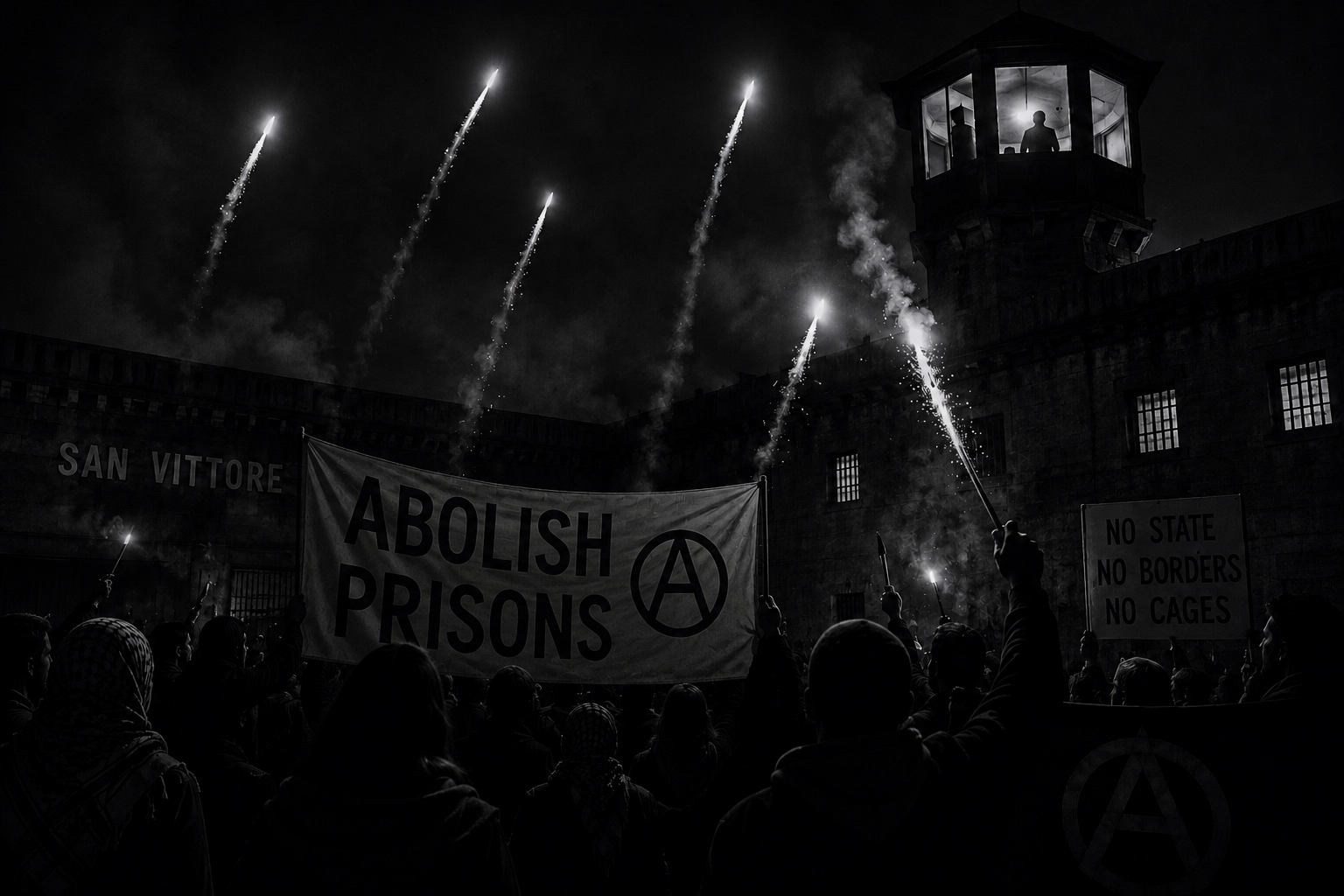
Comrades gathering together outside the prison at night to launch fireworks in solidarity with those inside
Introduction
The most common objection to abolitionism isn’t empirical. It isn’t “prisons work” or “policing reduces crime” — the evidence on those claims is, at best, deeply ambiguous, and at worst a standing indictment of the institutions that generate it. The most common objection is philosophical: abolition is utopian, premature, ideologically driven. Reform first; then we’ll see.
This piece argues that objection has the logic backwards. Abolition isn’t a political demand that competes with reform on pragmatic grounds. It is the conclusion that follows from taking the internal logic of moral justification seriously — the same logic that liberals and progressives already accept when they defend rights, consent, and legitimate authority.
The argument doesn’t require anarchist premises — it reaches them.
This piece makes a specific claim: carceral institutions systematically destroy the conditions that make moral justification possible. If that is correct, then the problem with prisons and policing is not merely that they are unjust or poorly designed. It is that reformism becomes category-mistaken. The question is no longer how to justify these institutions better, but whether institutions that undermine the very practice of justification can remain within the domain of legitimate political authority at all.
What Justification Actually Requires
When an institution exercises coercive power over people — arresting them, imprisoning them, subjecting them to surveillance and control — it makes an implicit claim: that this power is legitimate. That there are reasons for it that the people subjected to it could, in principle, accept.
This is not a radical premise. It is the foundation of every serious theory of political legitimacy. The state is not just force — it is force that claims justification. And that claim generates an obligation: as Philip Pettit’s republican theory has long argued, the state must be answerable, in some meaningful sense, to the people it governs — not merely efficient or well-intentioned, but structurally accountable to those over whom it exercises power.
What does answerability require? At minimum: that the person can receive the justification, evaluate it, and respond. That they have the deliberative resources to engage with the reasons being offered. That they exist, in short, as a normative subject — someone to whom reasons can be addressed and who can address reasons back.
This is the point at which carceral institutions fail. Not only on the grounds of their stated justifications — though those fail too, comprehensively — but on something more fundamental: they systematically destroy the conditions that make justification possible in the first place.
The Machine That Eats Its Own Grounds
Incarceration doesn’t just punish. It transforms.
People who enter carceral systems encounter an environment designed — not incidentally, but as its constitutive condition — to erode the foundations of deliberative agency. The deprivation of physical autonomy. The severing of social ties. The destruction of future-oriented planning. The systematic degradation of the self-understanding of someone capable of making meaningful choices. The structural production of learned helplessness dressed up, occasionally, as rehabilitation.
These are not side effects that reform could eliminate while leaving the essential institution intact. They are what incarceration is. A prison that does not involve coercive deprivation of autonomy is not a better prison — it is a voluntary rehabilitation centre, which is precisely what abolitionists have always proposed in its place.
The same structural logic applies to high-intensity policing. The encounter between an officer and a person being arrested is not a dialogue between parties with roughly equivalent standing. It is a moment in which one party holds the legal authority to use lethal force and the other has, in practice, no safe option for refusal. That asymmetry is not a malfunction. It is the definition of what policing does when it is working correctly. You can reform the training, the oversight, the rules of engagement. You cannot reform away the asymmetry without abolishing the institution that produces it.
This is coercion that is not a tool the institution uses. It is the ontological condition of what the institution is.
You Cannot Justify a Cage to Someone You’ve Locked Inside It
Here is the argument in its sharpest form.
Moral justification is a practice. It requires two parties: one who offers reasons, and one who can receive, evaluate, and respond to them. When the second party’s capacity for that response has been systematically destroyed by the very institution offering the justification, something more than injustice has occurred. The practice of justification doesn’t merely fail. It becomes structurally impossible — not because the arguments are bad, though they frequently are, but because the institution has eliminated the conditions under which justification could function as a practice rather than as performance.
You cannot justify a cage to someone you’ve locked inside it. The act of locking destroys the normative addressability of the person — their standing as someone to whom reasons can be genuinely offered and who can genuinely respond. What remains is not justification but a monologue directed at a subject the institution has rendered incapable of reply.
Carceral institutions are therefore not simply unjust by some external standard. They operate outside the domain in which the vocabulary of legitimacy, consent, and justification has purchase. And this is what makes reformism not merely insufficient but category-mistaken: every “better policing” proposal, every “humane prison” initiative, every procedural reform that leaves this structural condition intact is working on the settings of a machine whose operation forecloses the very practice the reform claims to improve. The evidence on what reform actually produces confirms what the argument predicts. The machine is not broken. It is doing precisely what it was built to do.
What Abolition Actually Claims
Abolition, understood this way, is a precise claim: institutions whose ordinary functioning destroys the normative addressability of the people they govern cannot be made legitimate through internal reform. Not because reformers lack ambition or imagination, but because the presupposition of reform — that the institution is, in principle, justifiable — is false.
This claim does not answer every question about what comes after. It is not a blueprint. But it does answer the reform-first objection definitively and without evasion. Abolition comes before reform not out of impatience or ideological purity. It comes first because reform makes sense only inside the domain of justification — and these institutions have already exited that domain by design.
A Note on Abolitionist Practice
This argument is primarily diagnostic rather than programmatic. It does not provide a blueprint for abolition. What it does suggest, however, is that abolitionist practice should be oriented toward preserving and expanding the conditions of normative agency rather than managing their destruction more humanely.
If prisons and policing are objectionable because they undermine the possibility of justification itself, then abolitionist alternatives should be evaluated according to the opposite criterion: their capacity to sustain the ability of people to participate as answerable and reasoning agents within social life. This does not by itself settle debates about community accountability, transformative justice, mutual aid, or non-carceral forms of conflict resolution. But it does provide a direction of travel.
The task is not to design more legitimate cages. It is to build institutions that do not require the destruction of normative agency in order to function.
Reformers who understand this and continue to argue for reform are not making a pragmatic concession to political reality. They are making an error about where the ground lies.
That is not a political demand. It is a conclusion. And the difference matters.
Tommaso Biagi is a political philosopher working on structural power, moral justification, and anarchist theory.