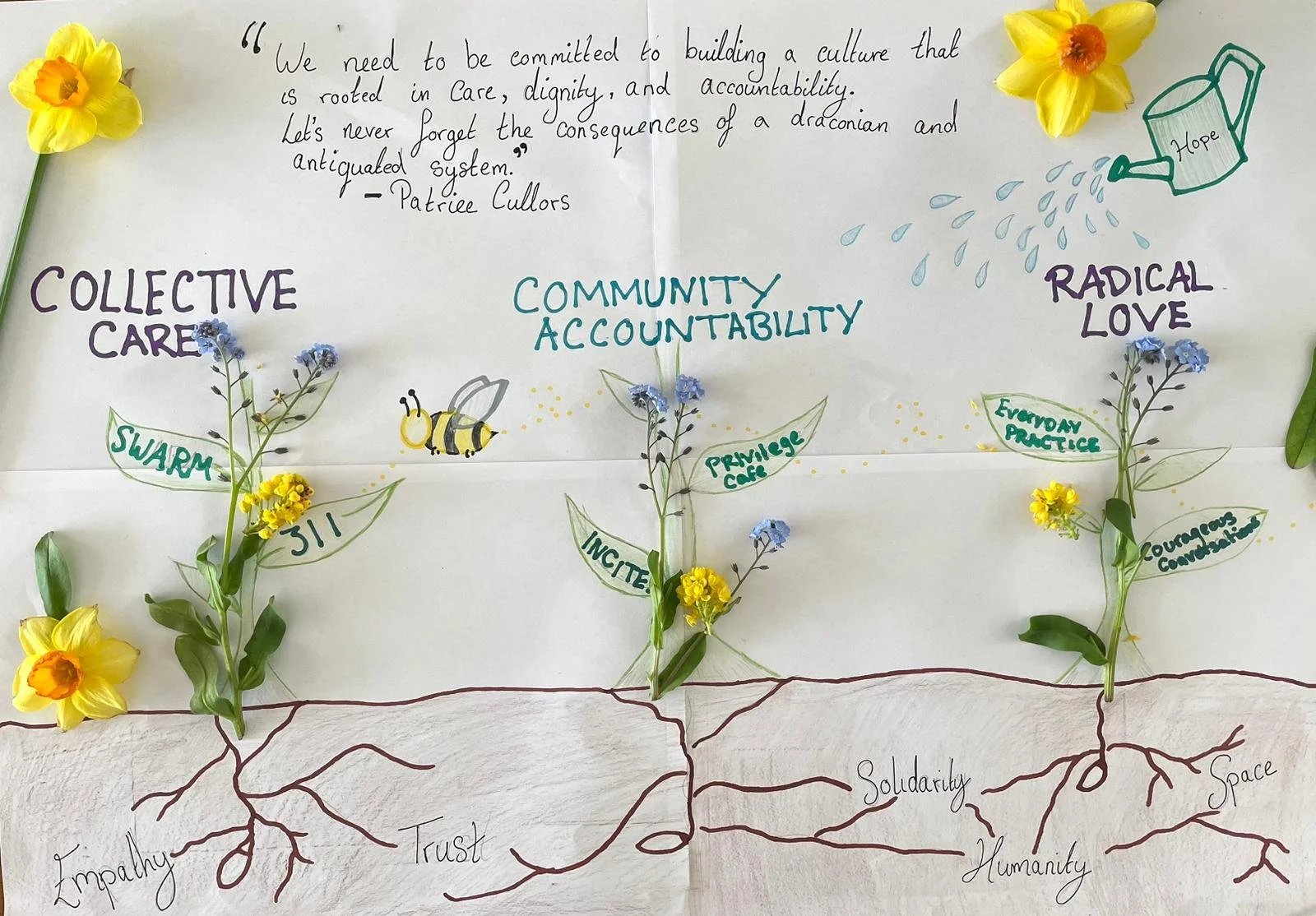
A visual to represent the abolitionist principles underpinning the article’s authors’ thinking.
By Emma Gant, Holly Mogford and John Moore
Part Two - An Abolitionist Agenda for Cymru
The second part of this article builds on our earlier blog that sets out the principles for an abolitionist Cymru, by seeking to contribute to the development of a ‘blueprint’ for an abolitionist Cymru. Rather than offering a fixed or complete model, this blueprint is understood as an ongoing, collective process of imagining forms of life beyond carceral logics. It asks not only how existing penal systems might be challenged, but what it would mean to organise through practices that centre care, accountability and love.
In this sense, the blueprint aligns with the work of CLR James and Grace Lee Boggs, who urged us to look for the ‘new society’ already emerging within the present, while asking how it might be brought closer. It also draws on Mariame Kaba’s insistence that ‘hope is a discipline’, that the work of abolition requires sustained commitment to building alternatives, despite the persistence of seemingly intractable systems of harm.
Collective care, community accountability and radical love in practice
Practices from around the world offer insight into what the expansion of collective care could look like within Cymru. In Atlanta, Georgia, residents can call 311 instead of 911 to access support. Rather than dispatching police, a two-person team responds, offering the required resources. Such models demonstrate that community-based responses can address harm without resorting to carceral systems. Another example of mutual aid through grassroot groups includes SWARM , which set up a hardship fund for sex workers during the pandemic, and harm reduction networks that distribute supplies and information for drug users. These examples further illustrate how communities already meet needs outside of state structures.
Furthermore, these examples underscore a crucial point: collective care is not the absence of response but the presence of different kinds of response - grounded in mutual responsibility. As these practices develop, questions are raised as to how communities navigate harm and conflict without relying on punishment or exclusion. It is to these questions that we turn to, exploring the possibilities of community accountability.
Practices of community accountability are already being enacted in different contexts. For example, the work of groups such as Creative Interventions and INCITE! offers insight into how communities can respond to harm without relying on carceral structures. In cases of interpersonal violence, people who have chosen not to engage the police have turned to trusted networks to collectively respond.
In these instances, a group is often formed around the person harmed to prioritise their safety and wellbeing. This can include securing housing, providing emotional support and establishing ongoing systems of care. At the same time, another group engages with the person who causes the harm, communicating clear expectations, facilitating processes of acknowledgement and supporting sustained behavioural change. The responsibility is not displaced onto the state, but held within relationships, requiring a commitment to transformation. Here, accountability is understood as a collective and relational process, as opposed to punishment.
Oppose reformist reforms
Following our previous paper, we continue to reiterate the need to resist carceral temptations of devolution within Cymru: namely reformist reforms. In the context of criminal justice, reformist reforms often seek to expand police powers, build new prisons and enhanced surveillance technologies. These reforms do not address the root causes of harm and instead entrench and expand the very systems that produce and perpetuate it.
One proposal from Plaid Cymru in seeking to improve access to justice, is to implement ‘courts in the community’, particularly in areas affected by court closures. This is also accompanied by commitments to address legal shortages and expand legal support access. On one level, this is a response to real and pressing issues and increasing access to legal support could reduce some of the harms associated with the current systems. Yet, expanding access to courts does not reduce reliance on carceral systems. The question here is whether reform challenges the role of courts as mechanisms of control or simply makes them more ‘efficient’. Improving access to justice would need to be accompanied by a broader shift away from punitive systems to community-led networks of support.
Central to Plaid Cymru’s wider demand for the devolution of policing and other ‘justice’ functions is the belief that the Cymreig government would improve their efficiency and effectiveness. What is not acknowledged is that these agencies of the British state would continue to function to promote the same interests. As one of us previously argued, they would remain British police.
These and other reformist reforms inevitably lead to increased expenditure on the criminal punishment system, resources that are removed from other areas of social need. They believe that the British justice system can potentially work with reform and more investment. Reformed carcerality remains carcerality, and is often better resourced carcerality. Any reforms that do not defund and reduce the size and power of the carceral state must be resisted.
Instead, we must centre non-reformist reforms. The concept of non-reformist reforms provides a critical tool for distinguishing between reforms that stabilise carceral systems (reformist reforms) and those that work to dismantle them (non-reformist reforms). The distinction highlights how many reforms operate and are sustained within the existing structures of power, aiming to improve the efficiency and/or legitimacy of institutions without challenging the underlying carceral logic.
Promote non-reformist reforms
Non-reformist reforms are committed to transformative actions. They aim to reduce the power of oppressive institutions while simultaneously moving towards alternative infrastructures rooted in care and collective responsibility. Effective reforms must be, as Thomas Mathiesen (1974) demanded, of the ‘abolishing kind’. They must both contradict the logic of the existing system and oppose it by fostering new forms of social organisation. In this sense, non-reformist reforms are not simply policy interventions, but political strategies that aim to disrupt the balance of power, building collective capacity while dismantlingthe logics of carceral solutions.
Previous manifestos of Plaid Cymru include proposals to establish community-based women’s centres across Cymru to support those who would otherwise be subjected to custodial sentences. The risk here is that, if such centres continue to operate through logics of surveillance and conditionality, as seen in recent proposals for residential women’s centres, they will function as alternative sites of control rather than genuine alternatives to punishment. The potential for non-reformist practice lies not in the proposal itself, but in the broader approach it gestures toward - providing support outside the prison and crucially beyond state control. This is only realised, however, when these centres are community-led and orientated toward care and support. Such reforms frequently serve to stabilise punitive systems by simply addressing their most visible harms while leaving the structural foundations intact. Abolition is not about eliminating institutions in isolation but about transforming the conditions that render them necessary.
In the context of Cymru, this ambiguity becomes politically urgent, as investments framed as progressive may further embed carceral forms of government. For example, Plaid’s commitment to increase NHS funding, recruit 500 GPs and implement new strategies is framed as addressing inequality and improving outcomes. On the surface, such policies appear aligned with abolitionist principles. Access to healthcare is a key component of harm prevention and underinvestment in health services is closely linked to criminalisation, particularly for marginalised communities. Through a non-reformist reform lens, strengthening healthcare systems can reduce reliance on punitive responses to social problems. For example, improved access to mental health support may reduce the use of police as first responders. Yet there is a significant risk in viewing welfare and health systems as inherently benevolent, as these systems can function as sites of surveillance and discipline. Expanding healthcare provision without addressing this issue risks reproducing carcerality within care. Thus, NHS investment can operate as a non-reformist reform when it is orientated toward universal, unconditional care that reduces state coercion. Conversely, it may function as a reformist reform when it expands bureaucratic oversight and conditional access.
Abolition and devolution
The relevance of non-reformist reforms to Cymru becomes particularly clear in light of ongoing debates around justice devolution. Devolution is often framed as an opportunity to create a more humane and responsive justice system, aligned with Cymreigsocial policy traditions. Yet, without an abolitionist framework, there is a risk that devolved approaches will replicate existing punitive logics, leading to the expansion rather than the reduction of carceral power.
This risk can be understood as a form of ‘carceral creep’, where systems of control extend into new areas under the guise of reform. For example, policies that emphasise early intervention, risk management, or public protection may appear progressive while ultimately expanding surveillance and control.
The blueprint proposed here is therefore intended as a tool for intervention. Rather than accepting devolution as inherently progressive, here we intend to initiate a framework through which organisers can critically engage with policy proposals and practices, identifying those that reduce reliance on carceral systems and those that risk entrenching them. In doing so, it seeks to initiate a conversation that shifts the terms of debate, positioning abolition not as a utopian abstract ideal but as a practical and necessary response to the failures of existing systems.
Everyday practices of abolition
One of the central challenges that abolitionists face is encouraging imagination of a world beyond carceral institutions. The penal system often appears as an inevitable fixture of social life, despite the violence and harm produced being precisely what it was designed to achieve within the state. What is required, then, is not only critique but also imagination, and the capacity to envision and enact alternative ways of living and relating to one another that do not rely on punishment.
Everyday abolition emphasises the importance of connecting structural transformation with daily practices, recognising that the work of alternative futures begins in the present. This practice involves identifying and challenging ways in which carceral logics shape everyday interactions while cultivating practices that reduce and aim to remove the reliance on punitive systems.
Abolition is fundamentally about presence rather than absence, it is the creation of humane and affirming social structures and relationships that make carceral systems unnecessary. This approach shifts the focus from what must be dismantled to what must be built, highlighting the importance of care, accountability and collective responsibility.
Conclusion
In collating these conceptual tools and practices, we aim to contribute to an emerging blueprint for an abolitionist Cymru. Such a blueprint cannot be a fixed plan, but must be a constantly evolving framework that can guide organising efforts in the present, and thus constantly evolving. As such, this paper is a call to develop an abolitionist movement within Cymru. This paper has pointed to the rich tapestry of abolitionist thought within Cymru and beyond. Our intention for this invitation is to connect our abolitionist struggles across Cymru. In doing so, we’ll strengthen our resistance against carceral logics and work to build transformative futures. Such movement building offers a way to evaluate reforms, identify opportunities for interventions and articulate demands that reduce reliance on carceral systems.
Together, we call to seek out James & Bogg’s ‘new society’ within the present. This work is ultimately concerned with making visible and strengthening the practices that already point beyond carceral logics. It is through the expansion of these practices that the conditions and space for abolition can be created. In the context of Cymru, the question is not whether justice should be devolved but what kind of justice is being built. Without an abolitionist orientation, even well-intentioned reforms risk entrenching punitive systems and deepening existing inequalities under the guise of progress.
References
Mathiesen, T. (1974). The politics of abolition: Essays in political action theory. (No Title).
Emma Gant organises around sex workers rights and family policing, Holly Mogford organises towards migrant justice, John Moore organises with Abolitionist Futures. They are involved in abolitionist organising in Cymru and would love to hear from other abolitionists.