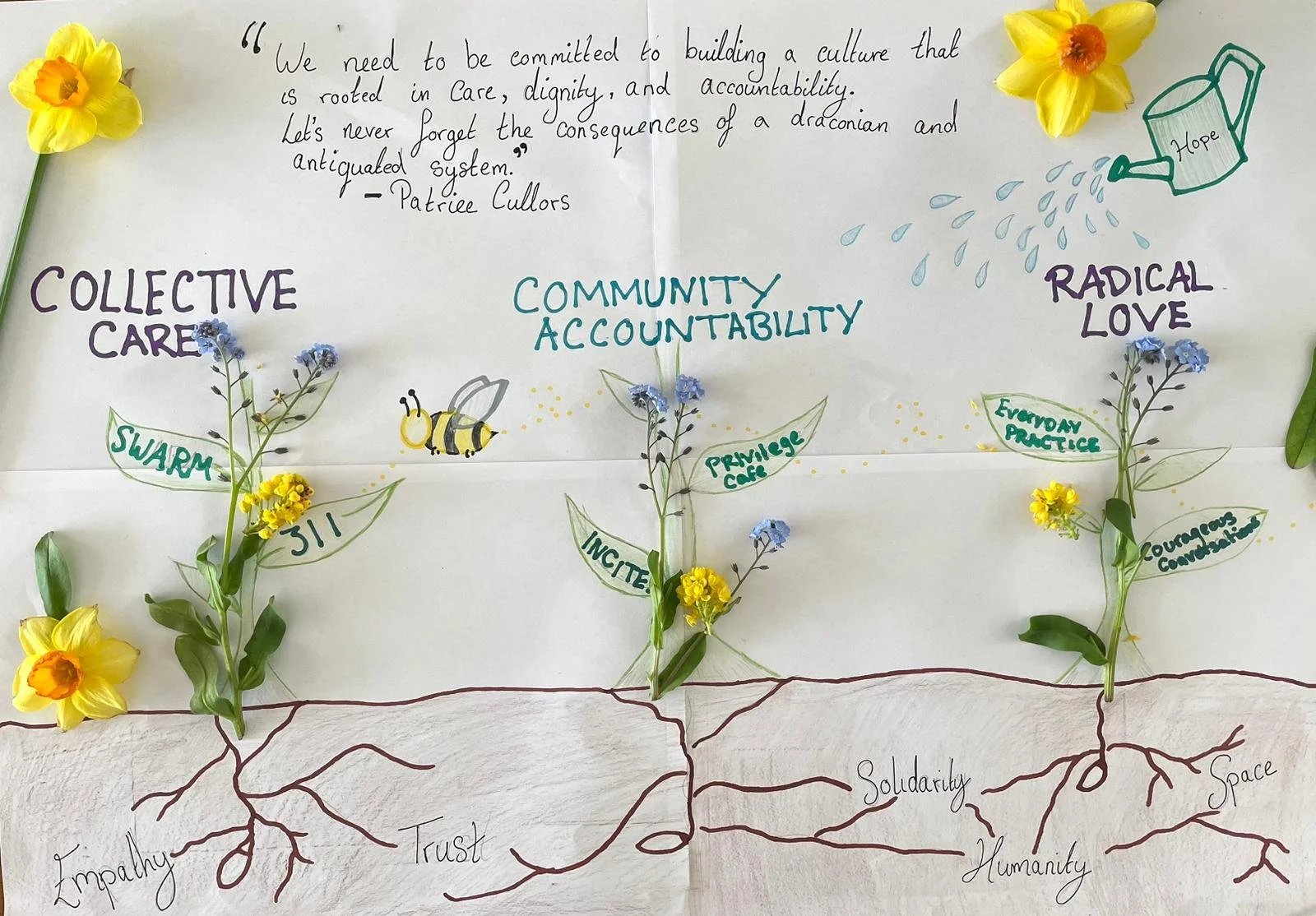
A visual to represent the abolitionist principles underpinning the article’s authors’ thinking.
By Emma Gant, Holly Mogford and John Moore
Part One - Abolitionist Principles
We need to be committed to building a culture that is rooted in care, dignity, and accountability. Let's never forget the consequences of a draconian and antiquated system
(Patrice Cullors, 2018, p. 1694).
We live in the devastating grip of carceral logics which operate globally to preserve racialised capitalism. Despite encompassing a sense of uncertainty, what remains clear is the necessity of imagining, and building ways of living beyond carceral logics. These relations and ways of living exist yet have been pushed to the margins as the racial capitalist state dismantles that which lives outside of its extractive and exploitative functioning. A recognition of the global context within which abolition is situated is integral. Yet, at the same time, we understand the centrality of inter-personal relations - which requires organising at a local level - in establishing life-affirming sensibilities and practices. As such, this paper moves towards imagining what living beyond carceral logics would feel and look like within Cymru. Our intention is not to offer a fixed ‘blueprint’ for abolition. Instead, it’s an invitation for others to join us to galvanise energies across Cymru to build a concerted abolitionist movement. This invitation is offered alongside warnings of the carceral temptations of devolution. But first, the context of Welsh politics.
Cymru (Wales)
Cymru is one of the four nations that comprise the United Kingdom of Great Britain and Northern Ireland (UK) and has a population of approximately 2.2 million people. Since 1998, Cymru has seen devolution in limited areas, with some government decision-making and administration being transferred from the UK government in London to the Senedd (Welsh parliament) and the Cymreig (Welsh) government. Significantly, unlike Scotland and Northern Ireland, its criminal justice functions are not devolved but remain entirely integrated into the English legal system.
For over 100 years, Cymru has consistently voted for the Labour Party: in local elections; Senedd elections; and UK parliamentary elections. However, opinion polls suggested that in this year’s Senedd elections the Labour party will, at best, come third, with the nationalist party, Plaid Cymru expected to be the largest party and the right-wing populist Reform party likely to come second. It is anticipated that Plaid will become the new government by either winning sufficient seats to form a majority government, or more likely as a minority government or in coalition with the Green party. This will result in calls for significant extensions of the powers devolved from London to Cardiff. If such demands are successful, one area that is likely to see increased devolution is criminal (in)justice. In a previous paper we authored with Sam Hanks, we warned about the temptations offered by devolution. Devolving control of Cymru’s police forces, prisons, probation services and youth justice will by themselves offer no relief from their existing carceral logic and impact. By potentially enhancing the legitimacy of carceral institutions, devolution is likely to strengthen them.
In particular we identified how the advocates of devolution highlight the opportunities it presents for ‘diversion’, ‘integration’ and ‘partnership,’ innovations that are classic reformist reforms, designed to improve the effectiveness of carceral policy and strengthen criminal (in)justice institutions. What Cymru doesn’t need is Cymreig police, Cymreig probation or Cymreig prisons. It is not where police, probation and prisons sit within the state that is the problem, it is the very institutions themselves that are problematic. The fundamental problems faced by the Cymry (Welsh people) are not that the criminal (in)justice system is controlled from London; but that it is inherently oppressive and that police and prisons compound rather than address the social problems faced by Cymru, such as increasing poverty, poor quality housing and homelessness.
Whilst clearly seeing the limitations of devolution, we recognise that it will become central to the aspirations of the new Welsh government, and indeed may in part become a reality. Rather than just critiquing the limitations of devolution, we are seeking to identify opportunities for broader abolitionist interventions that both decrease the scope and power of carceral institutions and start to build spaces and resources within communities that reduce reliance on the police and punitive responses to social problems and conflicts.
Principles for Abolitionist practice in Cymru
In recognising Cymru as England’s first colony, we become conscious of how colonial thinking infiltrates our ways of relating and recognising one another’s humanity. As such, our thinking must be in opposition to colonial and therefore carceral logics. From this perspective, three practices emerge as central to building this world: collective care, accountability and radical love. These practices are not abstract ideals but tangible ways of relating and living that have been deliberately constrained or erased by the capitalist state, which systematically undermines forms of life and social relations that exist outside its extractive logics.
Collective Care
Feminist abolitionist thinkers across the globe have emphasised the necessity of collective care. At the forefront of our thinking is a recognition that collective care will be different depending on the community context. Hence, our intention is not to provide a rigid set of contours. Rather, by drawing on a history of Welsh culture, we present some possibilities of this practice.
The village was valued deeply by our ancestors both within Cymru and globally. As family members recount narratives of the village, collective care was a daily practice. Having a deep connection to those who lived within the village was significant. This did not mean that everyone within that community necessarily agreed; however, their humanity was recognised. This reclaiming of humanity is central to the practice of collective care. The capitalist mode of expropriation produces ‘social separateness’, dismantling relations between human beings in their original state, in order for them to be reconnected in a way that serves the capitalist system. The implications of this are that we are not feeling one another’s humanity. Therefore, in practising collective care, we must reclaim closeness. This closeness must be practised within friendship circles and with those beyond our family structures. We must recognise the transformative possibilities of friendship towards collective liberation. Reclaiming authentic friendships, which resist capitalist demands of individualism, is central in the practice of collective care.
Capitalist structures attempt to position those we cross paths with daily as anonymous figures. Some of these figures have been employed by multi-billion-pound corporations to craft coffees in the most efficient ways. Others may be working in precarious conditions, without documents, washing cars in the bitterly cold. Hence, through these processes, these anonymous figures are merely encountered as a cog in the making of bitterly sweet drinks, or squeaky-clean cars. Yet, this attempted dismissal of humanity is resisted daily and this resistance appears in many forms. For instance, deep conversations which connect our humanity against the warmth of laughter work to dismantle capitalism's urge to separate us from one another. Radical friendships and everyday solidarities blossom between passer-byers and anonymous figures – unravelling anonymity whilst revealing one’s humanity.
In imagining and building ways of living outside of carceral logics, such friendships, grounded within our humanity, are central. As we expand our friendships, connecting with those who capitalist structures attempt to separate, we create potential spaces to cultivate movement building – working to dismantle embedded power relations which maintain the machine. Importantly these practices challenge the assumption that state intervention is required in response to social problems, instead foregrounding the capacity of communities to care for one another. Strengthening networks, mutual aid practices, relationships and collective systems is central to abolitionist organising, it actively dismantles the conditions that produce criminalisation, while building alternative forms of support. In Cymru, traditions of mutual support and community organising provide a foundation for such principles and practices. These forms of collective care already exist, for example, Queertawe, Palestine Solidarity Campaign Ceredigion-Ymgyrch Cefnogi Palesteina, Trans Aid Cymru and a range of groups largely operating invisibly as a survival strategy.
Having mapped out the importance of collective care, and its existence within Cymru, we turn to a specific practice of collective care; mutual aid. Mutual aid is a key component of abolitionist practice. It is not simply a reactive response to crisis, but a proactive commitment to dismantling harmful mechanisms of extraction through creating more caring and supportive ways of living. It seeks to enhance access to resources, particularly for marginalised groups - including disabled people facing ongoing cuts, migrants denied access to public funds, and sex workers who face criminalisation. In this sense, mutual aid challenges the inherent nature of state support, asking who is deemed worthy and under what conditions. Mutual aid insists that our needs should be met unconditionally, without surveillance and bureaucracy. Often, such projects do not perceive themselves as ‘abolitionist’, but their practices align with abolitionist principles. For example, Community Food Project Lampeter, which, unlike most food banks, operates independently from state and other welfare agencies, providing food parcels without the need for a referral or proof of deserving help.
Across communities, particularly those most marginalised, mutual aid already operates as a vital infrastructure. Grassroots initiatives provide spaces for safer drug use, access to life-saving resources such as Naloxone and harm reduction training, the sharing of legal knowledge and advice, and the redistribution of food, money and shelter. These practices must be grounded in trust and solidarity, rather than conditionality, which enables forms of support and care that are relational to lived realities. In doing so, they begin to build the resources to allow us not to rely on support from the state.
To sustain mutual aid, we must situate it within an abolitionist framework. Without this, there is a risk that it becomes a mechanism that compensates for state failure as opposed to challenging and disrupting the systems that produce harm in the first place. Abolitionist mutual aid is therefore both resistive and generative - it works against structures of extraction and violence while simultaneously building alternative conditions for collective life. It asks not only how we survive within oppressive systems, but how we begin to live differently, beyond them.
Community Accountability
As we become conscious of one another’s humanity, and we cultivate collective care within our communities, the practice of accountability becomes possible. First, we must recognise accountability as a daily practice. Central to the practice of accountability is an acknowledgement of the privileges we hold. This recognition has implications for how we feel and, therefore, act in spaces. An example of this practice can be found within the Privilege Cafe.
Turning our gaze back to our ancestors, travelling the village was grounded in a sense of safety. There was a recognition of the need to keep each other safe. Despite this recognition of each other's humanity, harm still occurred. Abolition reminds us of the centrality of practising accountability in response to harm.
A second key practice is therefore the development of community-based accountability processes in response to harm. Transformative justice frameworks emphasise that responses to harm should prioritise healing, responsibility and prevention rather than punishment. As seen in abolitionist toolkits and resources, communities are better positioned than formal justice systems to address harms in ways that are meaningful and supportive.
Community accountability involves recognising harm and taking the responsibility to work collectively to repair relationships and prevent future harm. It requires developing the skills and capacities necessary to engage with conflict rather than outsourcing these processes to the state. This work begins at the level of everyday relationships, challenging us to confront our own capacities for harm while building practices of care and accountability. As we move through this world, Patrise Cullors invites us to engage in courageous conversations. This includes honest and often difficult discussions that encourage us to speak openly about injustice, harm and inequality in order to build more caring and accountable communities. Through this willingness to be open, it presents possibilities for healing and strengthening relationships. Community accountability must operate at different levels depending on the harm which is being responded to. Yet, we all have a responsibility to work towards community accountability within our daily practice of being human. As we change ourselves, we change the world.
Radical Love
Building on practices of collective care and community accountability, radical love provides the ethical and political foundation for abolitionist organising. If collective care asks how we support one another, and community accountability asks how we prevent and respond to harm, radical love underpins both by transforming how we understand one another in the first place. Drawing on thinkers including bell hooks, radical love challenges the logics of disposability that underpin carceral systems. It insists that all people are worthy of care and thus justice must be grounded in processes of healing rather than punishment.
By prioritising connection, we begin to undo the social separateness produced under carceral governance. Practices such as building intentional support networks, engaging in difficult and honest conversations, redistributing resources and showing up consistently for one another are all expressions of radical love in action.
Radical love requires practice and plays a crucial role in sustaining movements. As Mariame Kaba reminds us, abolition is long-term work that requires hope and collective commitment. It is then by centring love as a political practice, that movements then cultivate the resilience necessary to continue this work. This can be seen in both our own and wider abolitionist organising in Cymru. Importantly, radical love does not mean the absence of boundaries or accountability. Rather, it insists that accountability itself must be rooted in care - to love radically is to hold one another responsible in ways that do not replicate harm, but instead create the conditions for change.
In this first part of this blog we have sought to identify the abolitionist principles that need to underpin abolitionist activity in Cymru. In the second part of this article we attempt to set out how these principles can be used to begin to develop an agenda for abolitionist organising in Cymru. Our hope is that these blogs will start a conversation across Cymru that leads to building a coalition which can challenge carceral logics and help build an abolitionist Cymru.
References
Cullors, P. (2018). Abolition and reparations: Histories of resistance, transformative justice, and accountability. Harv. L. Rev., 132, 1684.
Kaba, M. (2021). We do this' til we free us: Abolitionist organizing and transforming justice (Vol. 1). Haymarket Books
Emma Gant organises around the decriminalisation of sex work and resistance to family policing, Holly Mogford organises towards migrant justice, John Moore organises with Abolitionist Futures. They are involved in abolitionist organising in Cymru and would love to hear from other abolitionists.