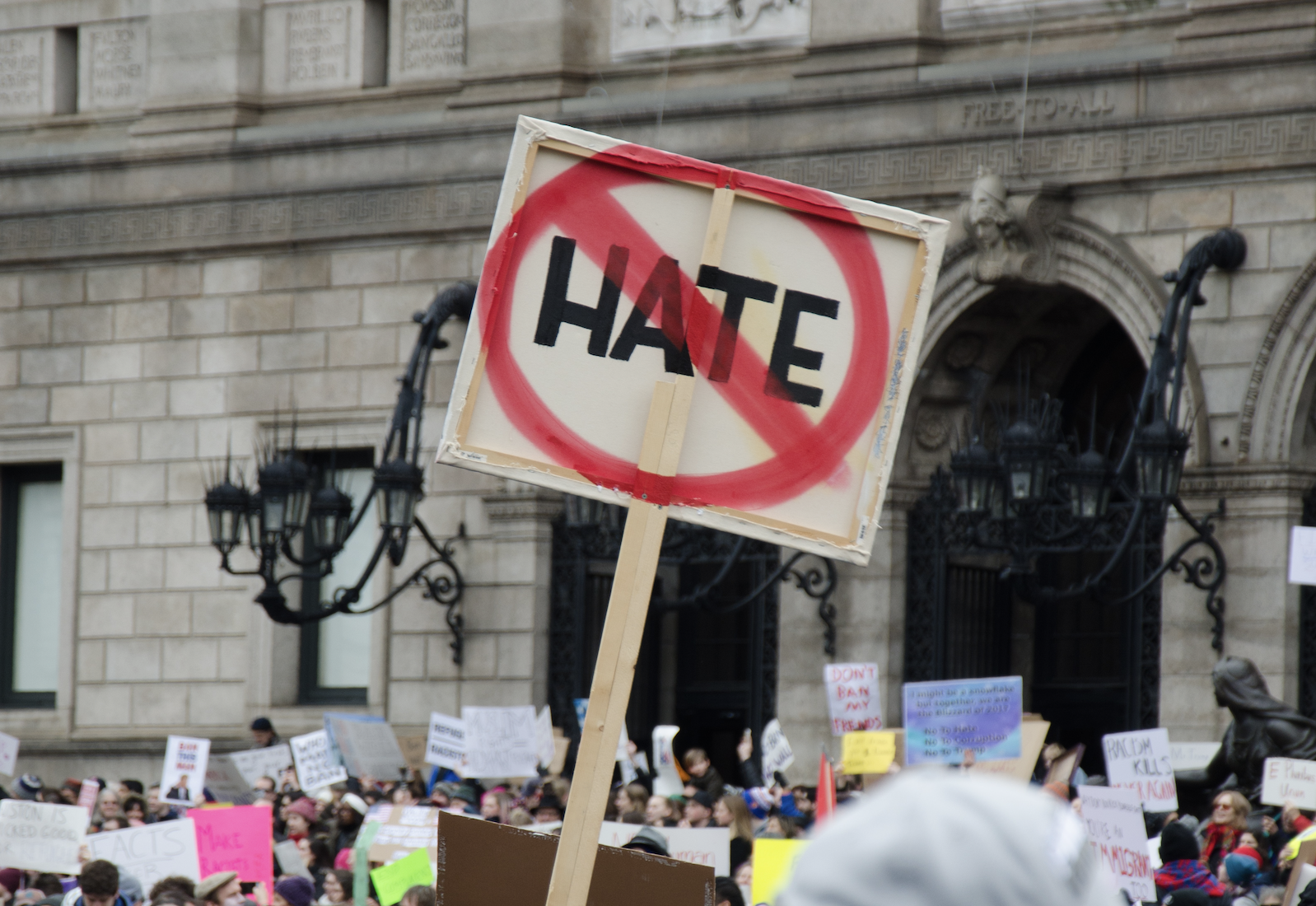
No Hate. Photo: © Tim Pierce (CC-BY-3.0)
By: Kevin Guyan
A razor-thin line exists between safety and danger for LGBTQ people. One misstep – a glance at the wrong person, a flamboyant hand gesture, a lilt in your speech – can mark a moment when you depart from one world (of perceived safety and protection) and barrel rapidly into another world (of exposure to danger and early death). When the switch happens, as it so often does, the response of the police and courts depends on who you are or are perceived to be.
‘Hate crime’ is a term used to describe behaviour that is both criminal and rooted in prejudice. It is premised on the construction and management of categories, which determine who counts and in what contexts. Yet, this process of classifying you as ‘something’ reflects societal assumptions about categories of gender, sex and sexuality: the lifestyles that count as lives, the practices deemed possible, and where these decisions locate you on a scale stretching between protection and harm.
These decisions are the product of existing power relations, designed to target oppressed groups and protect the powerful. By critiquing the use (and misuse) of identity categories in hate crime law, we can see more clearly how abolitionist approaches offer a way forward.
Hate crime in Scotland
My research and writing explore what happens at intersections where queer lives come into contact with different types of classification systems, whether it’s the identity labels presented in a national census, the datasets used to train AI models or the categories identified for protection in hate crime legislation.
I live and work in Edinburgh, Scotland and, on 1 April 2024, the Hate Crime and Public Order (Scotland) Act 2021 came into effect. This law consolidated existing protections, including sexual orientation and transgender identity, and introduced the offence of ‘stirring up hatred’, which criminalises threatening or abusive behaviour against a group of people with a shared characteristic (e.g. lesbian women, trans men).
As is the case in many parts of the world, a hate crime is not a stand-alone offence but a type of marker added to different incidents – for example, an assault, act of vandalism or murder can take the form of a hate crime. Hate crime law beckons the police into the intimate nooks of queer lives and affirms state agencies as arbiters for what lives count, who is worthy of protection and which types of hate matter.
Furthermore, the datafication of hate crime – executed via reporting apps, surveys, visualisations and statistical tables (my particular area of curiosity) – is prescribed for queer communities as something good for us. For example, in 2022, the Vodafone Foundation partnered with LGBTQ charities Stonewall and Galop to launch the Zoteria app, which allows individuals to record data about hate crime incidents and document the extent of the problem. This technology adopts a logic of visibility, where the collection of more data about hate crime makes the problem more visible and creates a stronger evidence base for action.
The reporting and policing of hate crime become a tonic. A justified impulse to wrong those who wrong us. I understand and recognise these feelings. I really do. But I am unsure if the expansion of hate crime law quenches this desire. As forcefully argued by activist scholars such as Lamble, Craig Willse and Dean Spade, the introduction of more LGBTQ hate crime laws does not necessarily mean that LGBTQ people are less likely to encounter anti-LGBTQ hate. Making a problem more visible does not necessarily attend to the underlying reasons why a problem exists in the first place – for example, the relationship between hate crime and social inequalities. A critical examination of the categories that underpin hate crime laws helps tell an alternate story that busts open the belief that more hate crime laws are something queer communities need or want.
Queer categories
The classifications used in hate crime law are not a carbon copy of the world ‘out there’ but are mediated through the design and implementation of legislation, reporting tools, training materials and public information campaigns. Classifying, as I argue in my book Rainbow Trap: Queer Lives, Classifications and the Dangers of Inclusion, involves establishing what markers of difference – among the many, many possibilities – are worth counting.
For example, Scotland’s Hate Crime Act presents a definition of ‘transgender identity’ that includes ‘a person who cross-dresses’, which might seem odd or offensive. However, this addition was made following evidence from the LGBTI human rights charity Equality Network, where they noted: ‘The inclusion of cross-dressing covers a potential loophole. Without it, any person charged with a crime against a trans woman, for example, which included the use of transphobic language, would be able to claim that they presumed the victim was a cross-dressing man’.
This example highlights what happens at intersections where state classification practices – codified in law and legislation – meet the hard-to-define complexity of queer bodies, desires and identities. Unlike the task of classifying phenomena in the natural world, like insects or plants, attaching categories to queer lives is like trying to pin jelly to the wall. Everything is moving: the person being classified, the person tasked with classifying them and the labels available to the classified and the classifier.
Spaces and places
Further muddying the classifications associated with hate crime are the spaces and places where they occur. During the drafting of Scotland’s hate crime law, the Scottish Parliament’s Justice Committee explored whether incidents within a private dwelling could count as a hate crime and agreed unanimously that just because an incident took place within someone’s home should not offer an absolute defence against prosecution.
This issue reminds us that the spaces and places where things happen can offer a cruel justification if (or when) something goes wrong – in other words, the queer person who locates themselves in a space not designed for them becomes partly at fault for whatever happens next.
The trans women using the wrong toilet.
The gay man drinking at the wrong bar.
The queer non-binary person commuting on the wrong bus.
The razor-thin line between safety and danger becomes even thinner when LGBTQ people are presented as locating themselves in the wrong place at the wrong time. Exposure to harm and access to protection are not distributed equitably among all LGBTQ people but vary according to intersectional privilege and the spatial contexts we all navigate.
The demand for definability
Finally, the very borders of categories of gender, sex and sexuality become a sticking point. Writing on the Hate Crime Act for The National newspaper in October 2023, former Member of Parliament Neal Hanvey made the claim: ‘You can’t protect what you fail to define’. This theme was repeated by other anti-LGBTQ politicians, including former Leader of the Scottish Labour Party, who – during parliamentary scrutiny of the bill – proposed an amendment to include a narrow definition of ‘sex’.
In April 2025, these demands were answered when the UK Supreme Court unexpectedly ruled on the meaning of ‘sex’ in the 2010 Equality Act, defining sex as ‘biological’ and ‘assigned at birth’. By using a definition of ‘sex’ that is binary, linked to biology and anchored in a historical moment, equalities law effectively excludes trans and gender non-conforming people from meaningful protection in law. While ‘common-sense’ categories for sex, gender and sexuality are perhaps alluring (for some), they are not universal – and when everyone is not included we create gaps, exceptions, outliers and box breakers.
Protection as a preserve of the definable
Protection cannot become the preserve of the definable. We can and should protect the lives of those whom the state is unable to define. Particularly, when ‘definability’ reflects the knowledge and experiences of the mainstream, cisgender, heterosexual majority.
But how is this protection best achieved? What is or is not definable is not just a bureaucratic or definitional problem but is shaped by the underlying logics and power dynamics of the criminal legal system itself. That system was never designed to protect vulnerable people. It was designed to uphold existing social, economic and moral orders, including the protection of private property and upholding of racial, gender, sexual and disablist hierarchies.
The demand that someone is ‘definable’ erases the undocumented, those without passports, ID cards or birth certificates; the wrongly documented, those who need to navigate the markers of F and M; and the unsure, those who do not know who they are or do not wish to know.
The many bodies that exist along different axes of gender, sex and sexuality: products of cultures, races, religions and beliefs that are antithetical to the classification demands of the white, Global North. There will always be identities, actions, lives and desires that are incomprehensible to the demands of classification regimes and related data practices.
What is ‘definable’ is therefore shaped by unjust logics and power relations. The solution, therefore, is not to try to improve how classifications are defined and operationalised as the development of more ‘accurate’ or ‘detailed’ categories will never include everyone. Instead, we need to abolish systems that use identity categories to justify harsher prison sentences (but do nothing to address the root causes of hate) and explore solutions that foreground forms of community protection and mutual aid not dependent on who the state defines as worthy of protection.
Scotland offers a test case that problematises a belief that more LGBTQ hate crime laws mean LGBTQ people are better protected from hate. As a blueprint for other nations to adopt or reject, Scotland demonstrates how demands for ‘definability’ coerce LGBTQ people into explaining their hopes, desires and identities using a vocabulary that is sensical to the state. You are included – as part of this queer nation – as long as you align with the categories of gender, sex and sexuality expected of you.
Kevin Guyan is a writer and researcher whose work explores the intersection of data and identity. He is the author of Rainbow Trap: Queer Lives, Classifications and the Dangers of Inclusion (Bloomsbury Academic, 2025), which published in paperback this summer. Ideas presented in this article are based on Guyan’s chapter in the open-access edited collection Queer in a Wee Place: Small Nations, Sexuality and Scotland (Bloomsbury Academic, 2026).