by Charlotte Carney
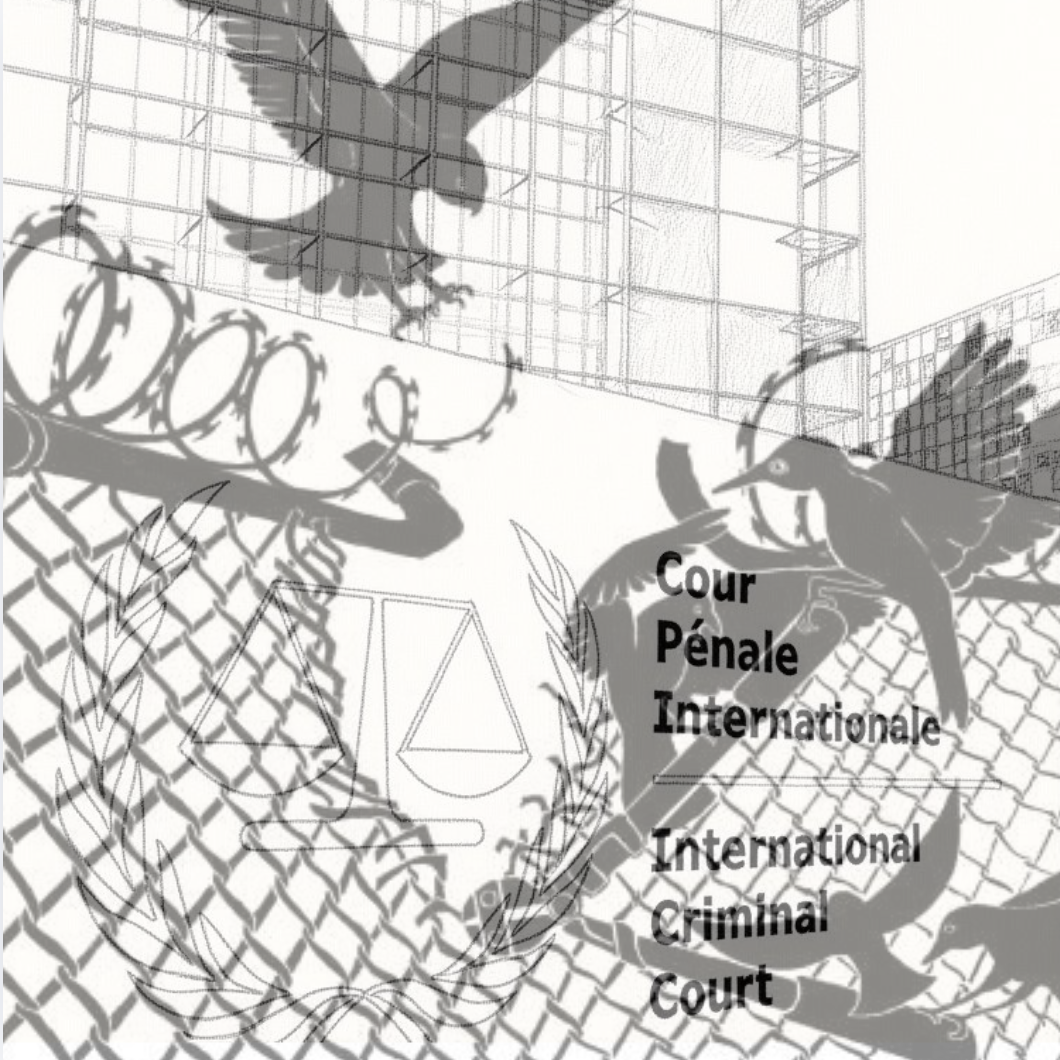
An abolition image superimposed over an image of the International Criminal Court (ICC)
The International Criminal Court (ICC or ‘the Court’) is an international court that tries and imprisons individuals charged with genocide, war crimes, crimes against humanity and the crime of aggression. The ICC, under the Rome Statute, Art.77.1,relies almost exclusively on imprisonment once it has convicted an individual. Thus, the Court envisions the deterrence of violence as an outcome of imprisonment. Yet, prisons are not a mechanism of deterrence. As abolitionists have shown, criminal legal systems target and police people of colour, with prisons being tools of racialised control traceable to periods of colonialism and slavery. The criminal legal system abstracts socio-historical contexts, and instead, responds to structural problems through punishment, namely, the punishment of the people affected by these socio-historical conditions of oppression and violence. The ICC does this on an international level. Three different areas of the Court: its racialised ordering; historical erasures; and reliance on prisons, demonstrate why abolition of the Court should be pursued.
Refusing the court’s racialised orderings
Since the ICC’s beginning in 2002, most of its cases have been from the African continent and concern African individuals. The ICC’s over prosecution of African states is justified by the Security Council, along with the racial logics structuring the Court. As Rachel López has highlighted, the permanent five members of the Security Council have veto power, allowing them to either push a case to the ICC for investigation, or to defer an investigation. The majority of this Council are white, Western states, who have used these powers to defer a number of investigations into their own violences. Instead, the ICC over prosecutes African situations, in part prompted by decisions made by white nations. This, in turn, produces a racialised cycle of punishment; the ICC over prosecutes African individuals, it then represents these accused individuals as “some of the world’s worst”, which in turn, further justifies the continued persecution and imprisonment of black and brown individuals. Due to the internationally normative and legitimising role of the Court, the disruption of this cycle is critical. This is where abolition becomes a necessity.
Considering the ICC’s recent issuing of arrest warrants for the genocide in Gaza, it may seem like the Court is entering a new phase of equitable accountability. Yet, a closer look at these arrest warrants reveals the enduring racist logics of the Court. The “equality” in this situation obscures the Court’s entrenched racial inequality. The ICC operates from the presupposition that state violence is legitimate but must be scrutinised in terms of “excessiveness”, while non-state violence is forbidden. Thus, when the ICC applies the same rules to both Israel and Palestine and issues arrest warrants for both “sides”, Israeli lives become absolutely protected, while Palestinian lives are measured through proportionality. The Court’s entrenched racial logics cannot be negotiated. This is why refusal becomes a necessity.
Abolitionists refuse to engage with or reform criminal legal systems which embed racial inequalities and hierarchies, arguing that criminal legal systems are made legible and kept viable through the policing of black bodies. The ICC’s focus on brown individuals is thus not coincidental but a core feature of the criminal legal system that it embodies. By refusing to engage with the ICC, we refuse to legitimise its racism.
The ICC’s decontextualisations and historical erasures
The ICC only prosecutes violence occurring after 2002. Through this narrow jurisdiction, the ICC neglects the social and economic conditions that produced the violence it attempts to address. However, abolitionists have shown direct links between structural disadvantage and imprisonment. Thus, systemic recognition is key towards justice that transforms conditions of oppression. Yet, this does not exist at the ICC. The Court does not engage with histories of foreign intervention and colonialism which often produced the social stratification and economic inequalities that then led to unrest and violence in a number of the ICC’s cases.
For example, in the Lubanga trial judgment, despite two expert witnesses describing the Democratic Republic of Congo’s (DRC) colonial past in detail the Court states that this past remains too remote to be of relevance. The Court’s resistance to engaging with colonialism leads to a historical recount that obscures how, and why, violence occurred in the DRC. Abolitionists show that this obfuscation of history is a function of criminal legal systems, and penal punishment. Angela Davis and other abolitionists argue that abstracting individuals from structural, and socio-historic conditions, is an ideological necessity for punishment to be associated with social change. Yet, such change does not follow imprisonment, because the imprisonment of individuals does not change the social and economic conditions that first fostered violence and conflict. This is where resituating violence, and history is critical. This moves us away from an individual focus, and instead, looks at how states need to be accountable, namely previous colonial powers. Shifting focus back towards the state system, and the liberal international order, reorients our gaze towards the violences that are produced through this racist system. Instead of constructing certain individuals as innately evil, we then can foster resistance to the continued disenfranchisement of populations by the state apparatus, along with the continued ignorance of ongoing systems of inequality, left behind from colonialism and necessitating reparative action.
Decentring, delegitimising and dismantling prisons and (international) criminal legal systems
Through its focus on imprisonment and its system of imprisonment, the ICC entrenches structural inequalities. The ICC does not exist outside of the domestic criminal legal system. Rather, the Court relies on this system to carry out the imprisonment of convicted individuals. The Court has enforcement agreements with a number of countries. Under these agreements, the ICC sends convicted individuals to serve out their sentences in the prisons of these countries. During the trial phase, the ICC imprisons accused individuals in their detention centre. Across these different countries, there are a wide variety of prison systems. Despite this, across these prisons, there remains high levels of suicide, mental anguish, overcrowding and a high portion of minority groups. This is due to the harmful nature of prisons, and the structural inequalities they uphold. The ICC contributes to these conditions when convicted individuals are sent to these institutions.
Abolishing the ICC remains critical. This involves physically dismantling the Court, but it also means delegitimising prisons, criminal legal systems, and decentring their role in global justice. This means undoing assumptions that imprisonment leads to justice, or that criminal legal systems produce justice. The ICC has been centred as an avenue for global justice and, as such, holds symbolic value. At the same time, it also normalises what “justice” is, and how it should be. Through its criminal law design, it solidifies the legal system as an avenue to “peace”, yet abolitionists show us peace through the criminal legal system is not possible. This is why decentring and delegitimising are key to dismantling the Court. We need to decentre criminal legal systems, and prisons, as pathways towards global justice. This, in turn, will have a significant effect on how we then legitimise these systems in domestic spaces.
Abolishing the ICC
Abolishing a court that prosecutes “war criminals” seems like a radical position to take, and maybe it is. Regardless, it remains a necessary one. Firstly, how we define “war criminal” is conditional on race, and power. The ICC exemplifies this, imprisoning brown bodies while it defers prosecutions against white states. It then, through its narrow temporal jurisdiction, absolves colonial powers of their violent regimes, and the long-lasting, enduring effects of these regimes. Instead, it rewrites history through its singular focus, constructing certain nations as randomly in conflict, and certain (brown) individuals as inherently evil. This continues racialised discourses of colonialism in a new space. Lastly, the Court directly contributes to, and supports, prisons. Through this, it inserts itself into the prison industrial complex, their racist practices, and logics, despite claiming to be a purveyor of “peace and justice”. The Court needs to be abolished, and abolitionism gives us the tools to do so.
Charlotte Carney (she/her) is a final year PhD candidate. She has research interests in international criminal law (ICL), and justice. Her research draws on anti-colonial and anti-carceral thought to critique the operations of ICL, investigating opportunities for resistance both within, and beyond this legal regime.