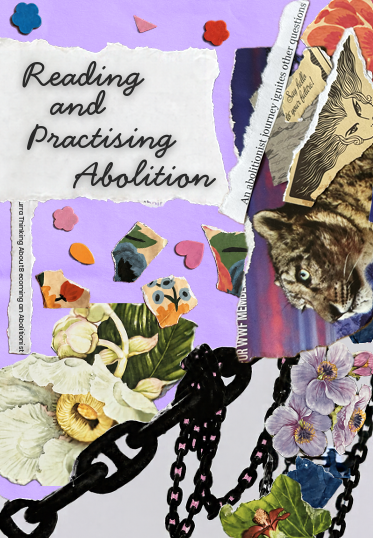
The front page of the zine we created for the project
How can drawing, painting, creative writing and collage-making help us collectively reflect, understand and act upon abolitionist texts? How can these arts-based practices enhance our collective political education? And what forms of connection, solidarity and “brave” spaces can we generate through the process?
Reading and Practising Abolition, a project I led in collaboration with Abolitionist Futures in 2026, aimed at exploring how creative and arts-based practices can support abolitionist political education. We were interested in how collective creative activities can stimulate alternative modes of thinking and disrupt traditional assumptions we hold about punishment and justice. We were curious to explore how arts-based and creative activities could enhance group discussions on abolitionist perspectives, challenging traditional approaches to prisons, policing, and borders, and foregrounding new forms of resistance and world-building.
The project consisted of three in-person reading group workshops at the University of Greenwich, each facilitated by members of Abolitionist Futures, where we invited the broader community to spend two hours together to read and reflect on selected key abolitionist texts, and to discuss them through the use of arts-based activities. We made sure we provided enough coloured pens, acrylic paint and scrap materials to boost participants’ creativity.
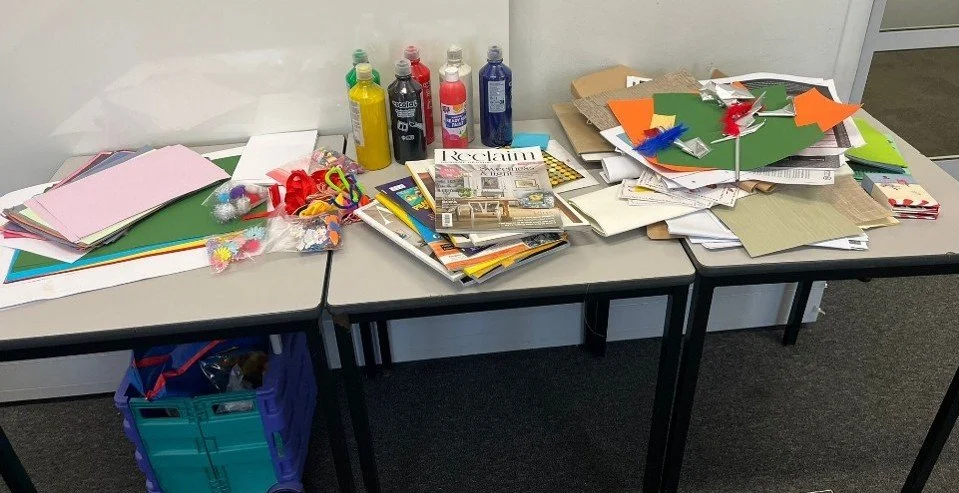
Before each session, AF facilitators and I discussed the appropriate core and suggested readings and the type of activity we felt could work well in the space, based on our past experiences and expertise. This resulted in rich and diverse sessions, where participants have been invited to engage with abolitionist knowledge and theorising, but also to get to know and to learn from one another, to co-create poems and sculptures and other pieces of art, and to disrupt power dynamics, generating a unique space of solidarity.
The interest and turnout have been quite unexpected – with 128 interested participants, and a total of 45 participants in one single session. This told us something about the appetite among the community for these initiatives, especially when they involve in-person workshops, where people can be in the same room and create something together. We also recognised that not everyone has the possibility or privilege to participate in a weekday evening activity hosted at a university in London. Reflecting on who was able to attend, and who was not, has also encouraged us to think more about accessibility and inclusion, and how future projects might budget for practical support for participation, such as costs for childcare.
For those who joined us, the workshops offered a valuable opportunity to step back, if only temporarily, from our individual pressures and preoccupations and engage with collective issues of injustice and social change, while also identifying connections between our own experiences and those of others.
The three sessions and the key texts we read and discussed
The three sessions explored a series of themes that have been adapted from the publicly available reading list and resources that Abolitionist Futures has developed and curated in the past decade.
Session one: Introduction to Abolition – Feminist, queer and anti-racist abolition
Core reading: Mariame Kaba (2020) - So You’re Thinking About Becoming an Abolitionist. Available at: Kaba-reading.pdf
Some of the suggested readings:
Angela Davis (2003) ‘Introduction: Prison Reform or Prison Abolition?; Are Prisons Obsolete? New York: Seven Stories Press, pp. 9-21.
Hajera Begum (2020) Rethinking Our Justice System: Abolition in the UK. Amaliah.com
Bassichis, Morgan and Alexander Lee and Dean Spade (2011) ‘Building an Abolitionist Trans and Queer Movement with Everything We’ve Got’. In: Captive Genders: Trans Embodiment and the Prison Industrial Complex, Oakland: AK Press, pp. 15-19 & 33-37.
Critical Resistance. (no date) What is Abolition?
Session two: Police, Prisons, Borders and state violence
Core reading: Adam Elliot-Cooper (2021) Excerpt from Chapter 6: Futures of Black resistance: disruption, rebellion, abolition. Black Resistance to British Policing. Manchester University Press, pp. 172-183.
Some of the suggested readings:
Abolitionist Futures (2020) Reformist Reforms vs Abolitionist Steps for Policing
Alex Vitale (2020) The answer to police violence is not reform: Its defunding. Here’s Why.
Francesca Humi (2025) Domestic work, care, and gender-based violence: Towards a non-carceral approach to migrant domestic workers’ rights — Abolitionist Futures
Mediocre Dave (2021) Policing by Consent - Abolitionist Futures
Should I call the Police? Steps to ask yourself before calling the police
Session three: Transformative justice and everyday abolition
Core reading: S Lamble (2021) Practicing Everyday Abolition. In: Abolishing the Police. Edited by Koshka Duff & Illustrated by Cat Sims. Dog Section Press.
Some of the suggested readings:
MPD150 (2020) 10 actions ideas for building a police-free-future
Creative Interventions Project (2020) What is our bigger vision? Creative Interventions Toolkit: A Practical Guide to Stop Interpersonal Violence.
Generation Five (2017) Ending Child Sexual Abuse. A Transformative Justice Handbook. GenFive_Transformative-Justice-Handbook.pdf
Ann Russo (2019) Chapter 6: Everyday Responses to Everyday Violence. Feminist Accountability: Disrupting Violence and Transforming Power. New York: New York University Press, pp. 132-155.
The space we created together
The format we used for these sessions was that of the “reading group”, which is used both in academic and activist spaces, and which is familiar to Abolitionist Futures. The reading group is based on values of conviviality, of reading, thinking and discussing texts together, co-producing a learning space, which for AF facilitators usually tended to be virtual, given the international reach of the collective. As we were working with a physical space this time, we were encouraged to think about the creative workshop in terms of embodied practice, reflecting on the meanings of producing abolitionist knowledge in a university room, and of redefining the university room as a site of abolitionist knowledge co-production. Together with Abolitionist Futures and three project participants, we are currently reflecting and writing on the successes and potential limitations in how we constructed this community abolitionist space, and how these spaces can be reproduced and sustained through/despite time, place and funding.
In the meantime, to give you a sense of the magical and ephemeral space we created, we would like you to read our collective poem to abolition – no scripts, no order, no explanation, no embarrassment, just one sentence after the other in the form of I can see or I can hear.
A poem to abolition
I can see myself receiving a call and there is this person who needs support with their abortion, and I'm helping her.
It's the day after an explosion and people are on the street sweeping up.
But it's because you need it. If you didn't need it, it would be a different story. And the rule does not have to be accepted.
I see a stranger ask if they would like the police to be called instead of immediately calling them.
I can see people talking with kindness.
I can see people who left the detention centres because they abolished the hostile environment against migrants.
I can see communal childcare, community cooking, and eating.
I see thousands of people or more; people are seeing whether the borders still exist.
I can see a world where we share food with our neighbours.
I can see a dance floor where people of all disabilities can dance freely in different ways.
I can see prisoners being released.
I can see total strangers feeding us after a long day at court.
I can see community mothering in action.
I can see people taking care of others even when they're at their worst.
I can see people helping each other after a disaster.
I can see landslide referendum results, and the bus driver lets me on for free.
I can see people in spandex bouncing to sweat out ICE in Minnesota.
I can see normal human suffering and comfort.
I can see birds breaking from prison, flying to…
Uh, I can feel freedom songs resonating from my bones and holding one up.
I can see a group of people holding space for someone after they have had a breakdown.
I can see people lifting each other, each other's kids, even though they don't speak each other's languages.
I can see the main character taking the perpetrator home, finding out that he has mental health issues, while the police are banging on the door to be there.
I can see a room full of people who have experienced so much harm healing together just by being together.
I see children everywhere laughing and playing freely.
I see us having daily conversations with our unhoused neighbours.
I can see our sweaty, scantily clad bodies organising autonomous spaces for pleasure.
I see a street normally filled with traffic filled with children, parents and elderly neighbours playing, chatting and getting to know each other for the first time.
Our zine to showcase participants’ artworks
As the project centres around issues of political education, activism and social change, the zine represented the (im)perfect medium for sharing participants’ collective vision, creativity, and diverse forms of expression. Although we (very loosely) positioned the artworks within broad themes discussed in the workshops, the zine enabled us to preserve and centre participants’ voices, questions and conversations, and make them available to a wider audience. In this way, it helped us reflect on our collective commitment to experimenting with alternative ways of co-producing and sharing knowledge.
The artworks showcased in the zine have been shared with participants’ consent, and are accompanied by a title and a short description in participants’ own words.
For more information about the project: ✨Reading and Practising Abolition✨ — Abolitionist Futures
The project was supported by funding from the Centre for Communities and Social Justice at the University of Greenwich.
About the author
Rachele Girardi (she/her) is a researcher, educator and activist currently based in Belgium. Her work is shaped by her involvement with abolitionist collectives and focuses on police violence, criminalisation, and the imprisonment of marginalised communities through queer and feminist perspectives. She uses creative and participatory research methods to centre the voices of people with lived experience of criminalisation and to imagine concrete possibilities for abolitionist futures.
Email: girardirachele31@gmail.com
LinkedIn: www.linkedin.com/in/rachele-girardi-7a8089130
Insta: @ggrrrrachel